Showing posts with label chamber music. Show all posts

Saturday, July 21, 2012

Humboldt Workshop Day Five--Beethoven and Bolling

"A Bunch of  Bassoons"
My fifth and final day of the Humboldt Chamber Music Workshop was a rousing success. I was assigned a favorite--The Beethoven Septet--and in the evening, had a chance to play the Claude Bolling Suite for Flute and Jazz Piano. The day ended with a big party at the dorm--with lots of conversation and tasty shrimp, chocolate cake, and beer (and more). It was a fine way to end another inspiring and remarkable week.

I was thrilled to get to play one of my favorites on Friday. The Septet includes bass along with three strings: violin, viola, cello; and three winds: clarinet, bassoon and horn. At the workshop, every daily group includes a different set of folks, but this one was packed with special friends. We had a fine musical and social day rehearsing the fifth movement, Presto, under the wise and wisecracking guidance of coach Ed Harris. As usual, we started out with enthusiasm but in need of a lot of improvement as an ensemble and ended up with a polished performance when we played at the end of the afternoon session. It was probably my best day of the week.

After the evening program, I spend an hour and a half on the Bolling. I had tried playing this before, and worked a little on it independently, but this time, with Nikki's strong piano and Loren's buoyant flute playing, I felt like a real Jazz bassist--and could see clearly the amount of progress I've made in just a few short years. I made plenty of mistakes and needed several restarts, but overall, it sounded pretty darned good. We were tired but satisfied at 10:05 p.m. when we played the final note. I have the feeling I'm going to be working on this piece for a long time, each session with more understanding and competence.

This being the last day, we were treated to a very humorous set of three bonus tracks, including the Rhythm Rockettes' Rock Trap--a clapping, dancing number, and two wind performances. The first of these was Doug McCracken's Quintette for Bassoons and Contra-bassoon, which presented seven of these senior woodwinds together. Besides the hilarious honking of the contra-bassoon, all seven participants appeared barefoot--emulating the composer. Doug only wore shoes--sandals at that--when he was forced to follow cafeteria regulations. The third piece was P.D.Q. Bach's Fugue of the Volga Boatmen, with a stage full of winds. It made me think about perhaps next  year coming up with a duet (or duel?) with my bass and the contra-bassoon.

Another special treat was a much-too-short performance of the Finale part I of the Magic Flute. The singing of Connie, Ellie, Diane and Miriam was nothing short of breathtaking, in its German (with English translation supplied on the double-sided program). The audience, with jaws dropped, gave them the standing ovation they deserved. We need to have this again--perhaps at greater length--in the main program next time.

Music is the center of this workshop, but what remains as the biggest memory is the people. I had some connections from my 2010 stay, but I made many additional friends this time. When I sat and read through the programs for the performances in the afternoon and evening, I saw name after name of someone I'd played with in a group, sat with at a meal or met somewhere on the Humboldt campus. We are all drawn together because of our love of chamber music, and the camaraderie and spirit is like nothing I've experienced elsewhere.

There's also something about the inspired leadership of Workshop Director Alan Geier, whose warmth, humor and brilliant management make this one of the best run events I've ever attended. Everything just works, and once you arrive at the Humboldt State University campus, you know things will be fine and fun. He also made it possible for me to attend on a Heagy Fund scholarship this year when financial issues made it look like I'd have to miss it. For this I am very grateful, and I want to thank him personally--and everyone who labors tirelessly to make our experience so special, including Workshop Coordinator Tom Phillips. The Heagy Fund accepts your tax-deductible donations year round. Contact the workshop for details.

I am indebted to my classical music mentor, Josh Cohen, as well. He has guided me as a fledgling upright bassist from my first tentative notes at orchestra rehearsal on the second day of January, 2007. He urged me to sign up for my first weekend chamber music workshop at CMNC in 2008, and my first Humboldt adventure two years later. He has supported my growth and brought me into this new world of people devoted to playing this timeless music together.

I will miss my fellow musicians, but I can always plan for next year, and I go home inspired to do more sight reading, work on my intonation, and find more opportunities to fill my calendar with music dates until I can travel to the workshop again.

Friday, July 20, 2012

Day Four--Challenges and Rewards at Humboldt

Hermann Goetz
As I discovered last time I came up to the Humboldt Chamber Music Workshop, there is one day that is a little tougher, and Thursday, for me, was that day. The piece I was assigned, the Quintett by Hermann Goetz (1940-1876), was a little more challenging, and so there were a few areas that I really didn't have down when we went on stage to play the piece. I had to work a bit harder during the rehearsal periods, and although I liked the feeling of stretching my abilities that the tougher piece brought out, it still gave me a little anxiety.

I was playing with seasoned musicians, too, so I didn't want to slow them down. I had a time in the afternoon where I needed to go over a couple of sections and it was still tough. But I can see now the areas that I need to work on to make my sightreading and technique even better for next year. And it still felt wonderful to participate in a day of "work" and to attend an afternoon and early evening of remarkable performances.

In the evening, after dinner, I went to the library to assist with the music. I'd never been inside it before--just to its front window--so it was an adventure. There were rows and rows of piles and piles of carefully organized manila envelopes of music, arranged by category. The numbering system was devised, I assume, to help musicians determine where to look for what they wanted.

After refiling some envelopes, I helped Tom to put away music that belongs to the University collection. We made lots of progress, although the job remained unfinished when I left three hours later. It felt good to do something to help the Workshop.

I then joined the party, which was in full swing at 11 p.m. and went past midnight. Hard to believe that this little island of delight in the sea of life is approaching its final day. I took a little stroll after breakfast on Friday morning:

The century-old Humboldt campus is beautiful

Thursday, July 19, 2012

Humboldt Day Three -- a Change of Pace

Samuel Coleridge-Taylor
The wise leaders of the Humboldt Chamber Music Workshop know that the extremely busy players need a little break in mid-event, so they have engineered Wednesday as a shorter day. By chopping out the afternoon practice session and scheduling the sampler program before dinner, they give attendees a chance to take a night off.

I had a great time with my extra evening, but first, it was a full day of music. I was assigned the Nonet in F minor by Samuel Coleridge-Taylor. I was thinking it was the poet, Samuel Taylor Coleridge, but the latter preceded the composer and is a completely different guy. Coleridge-Taylor, a product of an English mother and an African father, lived a short 37 years, but turned out a pretty good batch of music.

My first impression of the Scherzo, the piece we performed, was that it was spare for the bass. In truth, much of my part was runs of pizzicato (plucked) notes, but with some practice with my eight fellow musicians, it became interesting--and fun. The challenge was to play the runs properly-and in the right place. Because we occupied the main stage for our rehearsals, we got to go on first, so after a quick performance, we had the entire rest of the afternoon to sit and enjoy the other compositions.

Many were remarkable, but the one that stood out was Quintet by John Steinmetz (b. 1951). It started out with what sounded like the five winds tuning up and morphed into a drone piece, which was not only gorgeous but hypnotic. The crowd loved it. It's a real pleasure to see and hear the other groups' performances. Some apparently work out better than others, but we all know that sometimes the sound in the practice room doesn't get fully realized on stage. This is a workshop, and we tolerate the inevitable (and everpresent) imperfections. The different playing configurations let us get to know each other better each day.

After the performances, I treated myself to a 45-minute nap--I was bushed. But then, I took off with five others to the lovely Moonstone Grill, just a few miles up the coast, in Westhaven. We went there because it is a great restaurant with a sensational view, but also to remember a fellow chamber musician who is undergoing a bone marrow transplant now and who would much rather have been with us. We all hope he will be attending next year.

The food was wonderful. We shared crab rolls and oysters before the main course, which was beautifully prepared fish of various kinds. We also shared two bottles of Sauvignon Blanc from A to Z Wineworks. One of our party actually knows the owner of the winery, making it all the better.

We made it back by just after 8:30 p.m., in time to play more music. I had the distinct privilege to play two trio works for viola, cello and bass, a first for me. Thanks to Margaret, who knew the music and got it from the workshop library we three "lower strings" made beautiful music together. We played the Divertimento for Viola, Violoncello and Kontrabass by Anton Albrechtsberger and Leopold Hoffman's Trio Op. 1, Nr. 3.

The hour and a half flew by. The bass normally doesn't get to play with such a small configuration--I'm used to quintets as a minimum--but I've already played in a quartet and done these trios this week, besides the nonet from Wednesday, so who knows what the rest of the workshop holds?


Wednesday, July 18, 2012

A Double Dose of Schubert at Humboldt, Day Two

The Schubert Trout Quintet is a very famous and beautiful piece of music. Orchestral bass players often get to play it--or you may even say HAVE to play it--to satisfy the cravings of other musicians to play along with the biggest member of the string family.

Well, luckily, I LOVE the piece. I've already had two runs through it--and it's only Wednesday early morning.

The Piano Quintet in A major (Trout is really its nickname) is called that because it's based on a song Schubert wrote about the sad tale of a fish who struggles with the fisherman and dies (that's the thumbnail description). In reality, it is an achingly beautiful piece that gives a pianist and one representative from each member of the string family a workout.

My group met about 9 a.m. in our practice room to start. I was a little miffed because I had climbed the stairs to grab my bass, carried it all the way down to our morning meeting spot, only to find out that my assigned room was across the hall from my locker! Back up the stairs I went.

We quickly got down to business and the lovely sounds of the piece wafted through the room. After around 45 minutes, Daniela, our coach arrived. She did what good coaches do, and helped us identify areas we needed to work on (namely, all of it!). We selected the first movement and had to make a cut to get it down to a five-minute playing time. Then, we worked on the rough patches, and especially on the usual goal--playing well together.

We had no problem as people--I had a nice group-as I always seem to have. One of the many wonderful things about playing for five days in a row is that you get a different set of new friends each day. In this case, I had already played with two of the members and two were new to me. We worked through the piece in two morning and one afternoon practice sessions, broken up by our a.m. coffee break and lunch.

Strange for July--even in Northern California--was genuine rain--so our breaks were inside. I wore my porous and absorbent Levi jacket, but seemed to fare fine--it was not windy or particularly cold, so it just felt refreshing.

The joys of chamber music are great--if you like that kind of thing. We worked hard, but saw, over the day, our performance pick up speed, lock together, and by the end we were pretty happy that we had it down well. We drew the absolute final performance of the day, so we played after dinner. I wasn't sure I'd like that, but I had heard so much fine music by our turn that I was really in the mood.

After a brief reconnection before the evening session--and a few minutes in the green room, we stood backstage waiting, listening to a finely rendered trio just ahead of us on the other side of the curtain. Then, we strolled onto the stage for our turn.

It's funny that the stage looks far away from the seats but the people look close when you're up there. I glanced out briefly, but spent most of my time and attention on my music stand--and feeling my fingers on the familiar fingerboard of my bass as I listened and played along with our group. Nana, our violinist, counted us in and off we went!

The bass part has some wonderful half and whole note runs that flow below the more active melody parts that are incredibly enjoyable to play. One section, in the middle, is a piano solo, and I like to sing along with the part. One of my colleagues noticed this and teased me about it later (in a good-natured way, of course). Sorry, it's the Trout, and I can't help myself.

After our successful performance (we came back for a second set of bows), I went right behind the stage to a practice room to tackle Schubert's Octet. In this case, we played as a tiny orchestra, with violin, viola, cello, bass as well as oboe, bassoon, clarinet and horn (is that right?).

The piece is fairly long and twists and turns through slow and fast sections, but other than a few stops to re-sync ourselves, it flowed along nicely. I was pleased that all the players sounded good--and seemed to be having as much fun as I was. By around 10 p.m. we played the final notes, and smiles broke out everywhere. We had made it--and topped off another fine day of chamber music.

Then--two hours of drinking and snacking in the dorm meeting room. Ah, the college life!

Tuesday, July 17, 2012

Humboldt Chamber Music Workshop--Day One

Rossini
The chamber music workshop week always begins with a group meeting in the  main theater to learn the details of the week's activities and anything else you  might want to know to get around. This being my second time up here, I had a good idea of what to expect. Alan Geier, the workshop director, explained it all in his friendly, humorous way, welcoming us back--and helping to relax the newcomers. We learned where to get the music (the music library), details of the schedule, Do's and Don't's, things to watch out for, and the rest.

Then, we were released to go crowd around the posted lists of who's playing what with whom where. I got assigned to some Rossini quartets that include bass, in the Art Building. Luckily, it's just across from the main theater, but I still had to climb up the Music Building stairs (no elevator during construction) and grab my bass before I went there. But I arrived and found my musical companions.

One of the many beauties of the workshop is that you play a different piece, with different people, each day. Also, the professional coaches rotate, too, so you get the guidance of different experts. Since I'm the only bassist signed up (as usual) there is never a "bass coach," but our cellist coach was great at guiding the group to play well together.

First, we looked at the three Rossini quartets on our music stands and then decided on one to run through. We then isolated the particular section we would be devoting the day's efforts to "perfecting" and went with that. You have to do this to get good enough at it to do well in the afternoon recital.

Gioachino Rossini is best known for his opera, The Barber of Seville, and the piece we worked on had an operatic quality, with expressive voices from the different instruments. The violin even gets to "laugh." I had two sections of solo work that I was able to pull off during the afternoon performance. Whew.

Things started coming together and improved over the day. We had our first session, then took a break in the courtyard with coffee and snacks. I've always liked this part, both for the social pleasures but also to get a break for my hands--and my eyes. Unfortunately, I am the ONLY person who stands all day, and this is more standing. I really should find someplace to sit down.

I lollygagged a little longer, and found my cohorts already there when I returned. We worked on our quartet--two violins, a cello and me on bass--through until lunch, with direction from Carol, our coach. It's hard sometimes to sync your playing with the other musicians--but therein lies beauty and satisfaction. We gradually tune in to the others. Intonation improves, the speed increases, we get more even, and play sections in which we share the melody or pattern in the same way so it sounds euphonious.

In the afternoon, we played late in the first of the two hourly sessions. Just after we played, we went off to dinner. It seems like there's lots of eating at these events. The food is OK--but it is "dorm fare" and I heard some grumblings about the consistency and flavor of the chicken. We went back for another hour of fine performances--every group seemed to be aware of the five-minute rule so it rolled through. Then--off to freelancing.

Freelancing gives you a choice to play what you want when you've completed your daily assignment. I played the Schubert's Trout Quintet--a favorite of chamber music players because of its beauty and also it seems to be the first piece anyone thinks of that includes a bass. We bassists are not in the center of chamber music but on the periphery. So--I'm glad to play it, and usually, at least one of the five of us is doing it for the first time--exciting and challenging. We played it fairly slowly, but the group focused and really heated up the room. At last, it came to its satifying conclusion and we packed up and headed back to the dorms for a little alcohol, snacks and conversation.

And so ended the first day. Today, we do it all over again.

Sunday, July 15, 2012

Humboldt Chamber Music Workshop--Arrival

Here I am in my dorm room at the Humboldt Chamber Music Workshop at Humboldt State University! The trip up, around 250 miles, seemed like it would take forever, but it suddenly was over. We grabbed a quick meal at the Burger King on the way, saw some fine scenery through the van windows, and enjoyed some musical selections from my orchestra conductor/friend Josh. I rode up with Josh and his wife Genevieve to save gas and automotive wear and tear--and for the companionship.

We stopped at the Solar Living Institute for a break a couple hours into the trip. It features educational displays on sustainable living and a store full of cute and interesting stuff.

There are some wineries and rows and rows of vines along part of the trip. Trees--so many--especially the wonderful Richardson Grove of redwoods. Willits is cute. Eureka is kind of a letdown after the gorgeous scenery but it's full of the urban experience--in small scale.

Once I arrived it was a quick and easy check-in. I got my decorative and useful badge at table in the dorm, went to get a king-size locker for my bass, and got a cable for my computer. Unlike last time, this year I'm blogging the whole thing!

My room is much like the one I had last time, two years ago. Two tall, natural-wood single beds with stashing space underneath.  Twin dressers and desks.  Cement block walls that give a little of a prison vibe--but there's nothing depressing about being here. Soon, we'll be playing music, sharing meals in the Jolly Giant Dining Hall (The J), and freelancing in the evenings.

It's summer camp for grownups, really. Away from the troubles and cares of the normal week, you can concentrate on the task at hand--rehearsing chamber music during the day with a different small group each day, sharing five minutes of it with your fellow workshop attendees in the afternoon, and after dinner, playing some more.

I was amazed when I attended the workshop two years ago that my hands never got sore, even with the hours of bass playing. It's because I was so HAPPY, I guess. I'm beaming in the group photo. So, I have every reason to expect more of the same this time.

Stay tuned.

Monday, February 27, 2012

Weekend of Music and Beer

Somehow, the last three days became a whirlwind tour of music and beer. Today, starting with my oatmeal with almonds, I will get back to normal.

Friday night, I met three people from a company I work with through my job at the Devil's Canyon Brewing Company's monthly public events. Music was by Billy Manzik, featuring Billy on guitar, a guy on saxophone and a lady upright bass player (always a treat). It went well with the two beers I sampled--a light champagne style and the Kaleidoscope dark.

Afterwards, we went to a Louisiana style restaurant where a third beer, along with a pound of spicy shrimp, went down much too easily.

Saturday evening I went to hear the highly talented Stadler Gibbons Band, featuring Mike Stadler, Mary Gibbons, with ace pedal steel and dobro player Jon Mitguard and incredible bassist Chuck Irvin--who makes it look easy (it's not). They played at the Urban Island Concert Series, which takes place at the loading doc behind the Urban Island used furniture store. The evening began with a surprisingly entertaining duo, The Red Shoes, comprising two young ladies that appeared to be high school seniors playing fiddle with cello, occasionally switching up for ukelele. Their stage presence and apparent total lack of stage fright was charming--and they had the chops to keep it moving with just the two of them.

The next act, Emily Bonn and the Vivants, delivered a powerful shot of old-time dance tunes, honky-tonk country, and western swing. Emily writes a lot of her own material and her powerful voice invigorates the show. Accompanied by a tap-dancing violinist, a double-bassist with the longest mustache I've seen in some time, and a stirring accordionist, Emily's guitar playing and presence made this a group worth watching--and following.

Stadler Gibbons was the headliner, and they gave the kind of performance that has kept me following them around for the last year. Mike has the fine pipes of an old folkie, as does Mary, and the musicianship is extremely high level. As a bassist, I appreciate Chuck's versatility and style, and Jon's pedal steel is out of this world.

The beer this time had to happen afterwards, since the Urban Island provided a solitary Thai food truck (the roti was tasty, but no alcohol was available). We went to the Hobnob bar nearby for a couple glasses of Arrogant Bastard Ale. Yum.

Sunday I shifted gears and listened to fine chamber music performances by the Summer Quartet (strings) and the Hillside Quintet (winds) at my local library. All nine people are members of the Castro Valley Chamber Orchestra, of which I also am a member. Afterwards, some of the musicians went to a local Mexican restaurant for beer and, it turned out, some tasty food. (I had the golfos).

Now it, Monday, and time to get back to work!


Tuesday, October 25, 2011

Things My Mom Gave Me

Today, I'm using my 300th blog post of 2011 to thank my mother for all the things she has done for me. She was born on this day 81 years ago.

Of course, the first thing she gave me was life itself. And after she did, she breast fed me--the only new mother on the floor in the hospital to do so. She ignored the "modern" method of the day to do what was right. That gave me immunities (and closeness) that have made me a very healthy person my whole life.

Mom gave me time and attention. She stayed home with me, and didn't go off to work until I was a teenager. It was the times, of course, but it was good to have her there. As a teenager, I'd visit with her at night when she was resting from work and we'd talk about things, too.

Mom gave me the gift of music. She played the cello as I was growing up and filled the house with chamber music. I didn't know it then, but it would be something I'd love doing as an adult. For the last five years, I've played in a community orchestra and in chamber music workshops, just like she did--only my instrument is the bass--in the same string family.

Mom also bought a stereo system for our house, and not long afterwards, brought home Sgt. Pepper's Lonely Hearts Club Band when it came out. This not only showed how cool she was but also supported and expanded my love of the Beatles and guitar playing. Today, I play bass in a four-piece band, Red Paint, as a direct result.

Mom has shown me how to deal with loss and move on. After my parents' divorce, she found a new person--the love of her life--and even when she lost that person (who died too soon), she went on living a full life full of friends and activities. She has lost much of her hearing--and the music that comes with it--but she studies lipreading and sign language, still actively participating in life.

I treasure the time we spend together, and hope we have lots more.

Thanks, Mom, and happy birthday!

Sunday, May 29, 2011

When the Music is Over

Here I sit in my kitchen, on what would normally be the Sunday night before Monday's workday ("...not that there's anything wrong with that," as Seinfeld would say). It's just that after a weekend containing a full day of chamber music and a concert, it's over now. My spring Castro Valley Chamber Orchestra season ended this afternoon with a rousing performance of Borodin's Symphony No. 2, Mussorgsky's Pictures at an Exhibition and some very entertaining music from the bayan--the Russian button accordion. That's Mr. Borodin at the left.

I've written on this concert already--but the point is, what do you feel when something you've been looking forward to is over? After every concert, I feel the sense of accomplishment of a job (pretty) well done -- remember I am an amateur -- and a feeling of completion. And, I don't have to work on it anymore, so it's a little like freedom (school's out). But--when we finish a piece, it goes away. I no longer play it, and although it's added to my repertoire, and nowadays, to my iPod, it's over. So I miss the piece too. And, of course, I'll miss seeing my fellow orchestra members all summer, too.

As I've been harranguing my son lately, there's nothing quite like the enjoyment of accomplishing a goal. It's doing something with a purpose--not simply receiving something you like or want. It's earning it. I wish I had understood this earlier, but perhaps this knowledge, too, is something you have to earn.

Saturday, May 28, 2011

Another Chamber Music Workshop Is Done

It's late in the day, but I'm happy. I got to play chamber music on my bass all day today--and all evening too.

Over the last few years, I've attended gatherings of the Chamber Musicians of Northern California (CMNC) that take place three times a year at a San Francisco Bay Area campus. After about 12 of them I know the drill, and always learn something. Also, it's great to be with people who are interested in what you're interested in--and being a "workshop," it's about developing yourself as a musician--not being a perfect concert performer. Good thing, too, because I make lots of mistakes!

We were assigned a Piano Quintet by German composer Hermann Goetz, who lived from 1840 to 1876 (see photo). The piece was beautiful and challenging. Goetz wrote it late in his short life--1874, while he already was suffering from the tuberculosis that would kill him.

We opted for the slow second movement, and even after a day's work of practice, I never quite got it right. Some parts are simply harder to play. But it was worth it to try to figure it out.

My work on this piece helped me realize that it's one thing to play every day, but for my next step, I need to work more on the basics--hand position, intonation, bowing techniques, scales--to move to the next level. That's something worth knowing--and acting on.

After dinner, I joined seven other musicians in playing through Schubert's Octet--a favorite ensemble piece that gives the bass plenty to do. Much of it is easy to play (for me now) but there are some challenges. I did a better job than the last time I played it--gratifying.

Friday, April 15, 2011

Nonet

Yesterday, I had the great chance to play chamber music with eight other musicians in a nonet. If three's a trio and four's a quartet, nine is a nonet.

Chamber music commonly combines wind instruments or string instruments--think of the classic string quartet (two violins, a viola and a cello). But--some composers have used the larger ensemble to get a richer sound, mixing winds and strings into a mini orchestra. We had me on bass, plus a cello, viola, violin, oboe, clarinet, horn, bassoon and flute.

The group was about half men and half women in a range of ages but tending to those in their middle to senior years--but all full of vitality and energy. The photo is NOT us--as you can surely tell. The important thing was, we played together and made a good sound.

The difficulty of sightreading the selections varied. The first piece, by Louise Farrenc, was a beautiful mid-nineteenth century work by a female composer--a bit unusual--but it wasn't too much of a struggle. The second piece, by Bohuslav Martinu, was a hundred years newer, and had the intensity and intellectual brilliance of the 1940's. With its twist and turns in key, time signature and note length, it made for much more effort--and I got lost more often. This kind of chamber music is more work, but with enough practice could be a great experience.

A third piece, by Louis Spohr, was played as an Octet, because this bass player was called away. For what? Read tomorrow's post to find out. 8-)

Monday, April 11, 2011

A Double Dose of Chamber Music

Yesterday, I got to enjoy two chamber music concerts. Being in an orchestra and a member of the Chamber Musicians of Northern California, I have met lots of fellow players--and they sometimes invite me to come hear them perform at local venues.

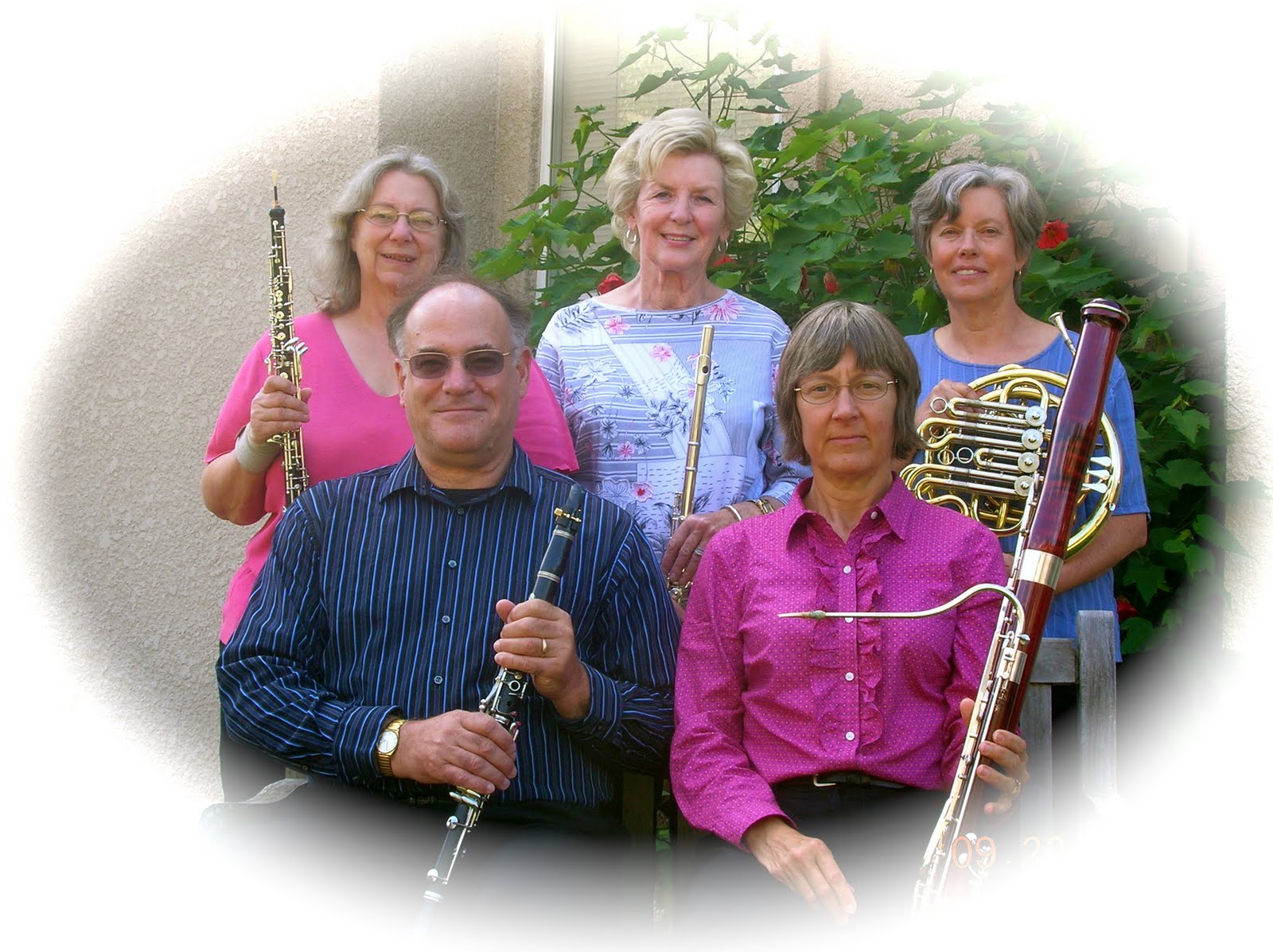
First, I drove to Alameda to the High Street Station to hear the Hillside Quintet, made up of five members of the Castro Valley Chamber Orchestra. They feature flute, clarinet, oboe, bassoon and horn. Their two sets mixed the popular sound of Mozart with the rousing refrains of John Philip Sousa's Liberty Bell March (the Monty Python theme), a surprisingly beautiful composition, the Andante by Muszynski from 1985, and other delightful pieces. They even played "Take Me Out to the Ballgame."

That's the Hillside Quintet in the photo above.

Then, I drove quickly East, to Pleasant Hill, where in the contemporary A-frame of St. Andrew's Presbyterian Church, four separate groupings of musicians (with a few folks playing in multiple ensembles) filled the building with great sounds. After Schubert's String Quintet in C Major (1828) came the biggest surprise of the concert--The Ballade, Pastorale and Dance by Eric Ewazen (born in 1954). In the unusual grouping of flute, horn and piano, it proved, as the Muszynski did, that modern classics can be a delight to the ear.


Sunday, March 13, 2011

Playing Music--it's Good for You

Last night, my band, Red Paint, played a party for a friend of our lead singer's friend. Free food and drink, interesting company, and an OK, if not inspired set.

We played between two sets by a tight blues band called Grease, Grit & Grime. They set up a fine background for the party, which featured beers on tap and a pig on a spit among other attractions.

Today, Sunday, I played my Spring concert with the Castro Valley Chamber Orchestra. It included beautiful music by Mendelssohn, Tchaikovsky and Chopin. The Chopin Piano Concerto No. 1 featured Lois Brandwynne, a brilliant pianist. What a joy to play along with her.

All of my adult music playing began in 2003, when I picked up my electric Fender bass. It was reinforced by starting the upright bass in 2004. Finding bandmates was great, but to play in an orchestra you need help. I found my community orchestra through the Adult School, but there is another way to do it--the New Horizons International Music Association.

I learned about this group in the AARP Bulletin. If you're 50 or over, you can attend one of the sessions and start playing a new instrument--or resume playing the one you gave up after high school. There are about 7,000 members in 182 orchestras, bands and choruses in 41 states and overseas.

Groups meet once a week for an hour lesson followed by playing together for another hour. I have found my two-hour weekly orchestra rehearsals, with concerts every three months or so, to work out perfectly. However, with an orchestra you may need some experience to join, but with New Horizons, you can start whenever you're ready, at whatever level you're at.

It can make all the difference in your life. I know it has in mine.

Sunday, February 13, 2011

Chamber Music--Good for the Soul

I just spent the weekend at a chamber music workshop put on by the Chamber Musicians of Northern California. I'm a very grateful member of this group of amateur musicians. Quarterly, we get together at a college or university campus to play music together.

I got to work on two exciting pieces this weekend. One was a Czech composer Dvorak's Bass Quintet. As a bass player I often play with groups with more than four other musicians--for example, an octet with 8 of septet with 7 (see the photo, taken last June). These groups include string and wind players.

For the Drovak piece, it was five folks with different-sized members of the violin family--violin, viola, cello and bass. What a nice sound. This is one of the "warhorses" of the bass chamber music repertoire, apparently, but it was only my second time through it and I'd gladly play it again anytime.

Today, I joined a dozen other musicians, all of whom were wind-powered, for a glorious Gran Partita by Mozart. We worked all day perfecting (well, improving) our performance and played some of it for some other musicians in the afternoon.

My hands, arms and lower back are sore now from my efforts, but I'm happy!

Thursday, February 3, 2011

Red Paint Rocks

Since I was 14 I've wanted to play in a band. I have strummed a guitar since then, but haven't ever been in a band--until 2006, when Red Paint formed. I hold down the bass part--which is what I love--and we have two guitars and drums--just like the Beatles (only not). In any case, we've played together for years and have a 25-30 song set list. We played more than a dozen gigs last year alone.

Tonight, with our lead guitarist, Shaun, temporarily missing, we had a fill-in, our mutual friend Thomas. And we had a keyboardist, Neal, sitting in. Red Paint as a five-piece band rocked. Our songs sounded extra full with the keys and Thomas did a great job covering the solos.

Makes a guy feel good. Watch for Red Paint to be in the local clubs again soon. (San Francisco Bay Area).

Friday, January 7, 2011

Orchestra Conductor for a Day

Here's a cool idea: At the Community Women's Orchestra's forthcoming Chamber Music Soiree, on Sunday January 23, at 2:30 pm., you have a great opportunity to bid to conduct a piece with the orchestra next season.

It includes a private conducting lesson with award-winning conductor Dr. Kathleen McGuire. The Conductor-for-a-Day also gets a souvenir conductor's baton, a photo with the orchestra, and a video recording of the performance.

Even though it's an all-female orchestra, the Conductor-for-a-Day can be male or female. So give it a shot if you've always dreamed of standing up there running the musical show!