Showing posts with label Castro Valley Chamber Orchestra. Show all posts

Thursday, May 23, 2013

Castro Valley Orchestra -- Concert Preparation is a Big Job


Three bassists from our last concert.
The Castro Valley Chamber Orchestra plays three or four concerts a year, and has done it for more than a decade. What you hear is the result of months of rehearsals and practice. Here’s how it works.

Tuesday is the official weekly rehearsal night. As it approaches 7 p.m., cars begin to arrive at Creekside Middle School. The musicians carry, and sometimes roll, their instruments into the school and down the hall. On the right, the band room door is usually open and folks stream in and go to their customary places.

The band room, with its tall ceiling, lockers on all four sides, and whiteboards, is used by the middle school for its music programs. It’s already set up with chairs and stands, but they may not be arranged perfectly, so there is some scraping and carrying before instruments come out of their cases and tuning begins. Many of the musicians have been playing in the group for years together, so there is plenty of friendly banter and telling of jokes, including some hilarious musical ones that are the specialty of a certain clarinetist.

Normally, music director Josh Cohen is already there, and he gets ready, sometimes passing out music for new pieces the orchestra will work on later. However, slowly, he is training the group to use the Internet to download and print out the music at home before coming to rehearsal.

By 7:15 p.m., it’s time to start. The oboist plays a piercing “A” and the other musicians match it, bringing the group into tune. Then, with a wave of his slender baton, the orchestra’s seasoned leader gets the 30 to 40 musicians under way.

When you attend a concert, you hear the pieces in their entirety, one after the other, but that’s not how the orchestra rehearses them. There are frequent stops and lots of repetition to get the sound just right. And it takes a couple of months to do it. Luckily, the sheet music is marked with measure numbers or a rehearsal number or letter to make sure everyone starts in the same place.

Sometimes, just the strings will play, and the winds sit and listen, thinking about how their parts fit in. Then, it’s their turn to play and the strings listen. Sometimes one section plays. Normally, before moving on to another piece—or a movement within it—the group plays the section through from start to finish. Knowing what to play is important, but knowing how it relates to the entire orchestra is essential to having a good concert.

The group works on the tempo—how fast or slow it goes. There are frequent changes in dynamics—how loud or quiet it is. Dynamics are especially tricky. The entire orchestra may change volume level together or some instruments may play louder to stand out, for example, during a solo. The entire orchestra or sections can change volume slowly, too. It’s very important to have these changes learned by concert time.

Josh, with support from the advisory board, made up of several members of the orchestra, plans the programs in advance. It can take time, and often costs money, to borrow all of the sheet music to a piece of music. It can cost several hundred dollars if it’s not available in public domain.

At about the halfway point, Josh calls a break and people go back to chatting and heading down the hall to the restrooms. Then, it’s back to work. “Let’s hear the violins and cellos at measure 147,” says Josh, in his friendly tone. Although he controls the musicians, Josh doesn’t holler at or berate them. That’s part of why the musicians keep coming back for more each season. The group meets from September to May, echoing the school year. As a part of Castro Valley Adult and Career Education, that’s natural.

It’s important to practice your part to learn the nuances and get it smooth for the show. I keep my bass in a stand in my dining room, so I can pick it up every day and work on the concert pieces. There isn’t time in the group rehearsal to do this.

The upcoming concert on Sunday, May 26, 2013 at 2:00 p.m. features four works, including Reinecke’s Harp Concerto. It takes place at the Castro Valley Center for the Arts at 19501 Redwood Road, Castro Valley. Adult admission is $10, seniors and children 13-18 are $5 and kids 12 and under get in for free.

Wednesday, August 31, 2011

It's Orchestra Season Again!

Tonight I resumed playing with the Castro Valley Chamber Orchestra--my musical pals since the beginning of 2007. Each year, from September to June, we gather on Tuesday nights at the middle school and rehearse for two hours each week, preparing for our three concerts per session.

Tonight we played a Mozart Double Piano Concerto that featured one of the most out-of-tune pianos I've ever heard. It made the great composer sound like the entertainment in a honky tonk bar despite fine playing by Tom. We also went through a piece this same fine piano player composed that will be a treat for anyone attending the upcoming concert on Sunday, October 23.

We tackled another Mozart piece, Symphony No. 31, which, unlike the Double Piano Concerto, I had never laid eyes on before. I was gratified at the amount of notes I was able to play on the first time through, sightreading. Part of the reward of playing in a community orchestra, besides the beauty and the camaraderie, is seeing yourself grow and improve over time.

Josh, our beloved and very hard working conductor, recommended playing chamber music to improve your sensitivity to other players, and I couldn't agree more. I belong to the Chamber Musicians of Northern California, which puts on three weekend workshops a year for players with at least some experience playing. I've attended about a dozen so far. The next workshop is the weekend of October 15-16, but you should join the group and apply now if you're interested.

Saturday, June 18, 2011

Paul McCartney is 69 Today

I seem to be getting into the famous musician birthday thing lately, but, as they do on KCSM, my local all-Jazz FM station, it gives me a chance to focus on a musical great. And Sir Paul means a lot to me--especially as a Beatle. He, along with John, George and Ringo, were my heroes when I was a teenager, and they influence me today.

Paul was my first major bass influence--and that's my instrument now. I wear my two primary basses on my left arm as part of that enthusiasm, and am a member of both my band, Red Paint, and my community orchestra.

Paul, having started as a guitarist and being also a piano player, is a more melodic bassist than someone who plays it as simply part of the rhythm section. His bass parts often take on a second tune--as in, for example, Something, where, if you tune out George, it's a whole different, low-pitched world. I've noticed that when it's one of Paul's songs and he's singing the lead, the bass part is simpler. When John or George (or even Ringo) is singing it, he often gets much more elaborate.

Paul played with a pick much of the time--I don't--but otherwise he's a big inspiration. I loved his Beatles work best. Something in the chemistry of the group--or maybe his youthful energy. I've bought and listened to later albums--even up to recent CDs like Memory Almost Full, but he no longer makes albums you want to play over and over. He has certainly released a lot of material over the years after his relatively brief Beatles career.

There are the great Paul songs, like Yesterday, Hey Jude and Let it Be, of course, and some favorites of mine. I always liked For No-One, from the middle period. When I'm 64 is catchy and he's the only Beatle who could write it. Best post-Beatle song? Maybe I'm Amazed comes to mind.

I saw Paul and his band--not Wings--play a few years ago and he put on a great show. Many of the numbers were Beatles songs--it was the next best thing to seeing the Fab Four in action. I wish him happiness today and for what I hope will be a very long life--and a great new marriage.

Sunday, May 29, 2011

When the Music is Over

Here I sit in my kitchen, on what would normally be the Sunday night before Monday's workday ("...not that there's anything wrong with that," as Seinfeld would say). It's just that after a weekend containing a full day of chamber music and a concert, it's over now. My spring Castro Valley Chamber Orchestra season ended this afternoon with a rousing performance of Borodin's Symphony No. 2, Mussorgsky's Pictures at an Exhibition and some very entertaining music from the bayan--the Russian button accordion. That's Mr. Borodin at the left.

I've written on this concert already--but the point is, what do you feel when something you've been looking forward to is over? After every concert, I feel the sense of accomplishment of a job (pretty) well done -- remember I am an amateur -- and a feeling of completion. And, I don't have to work on it anymore, so it's a little like freedom (school's out). But--when we finish a piece, it goes away. I no longer play it, and although it's added to my repertoire, and nowadays, to my iPod, it's over. So I miss the piece too. And, of course, I'll miss seeing my fellow orchestra members all summer, too.

As I've been harranguing my son lately, there's nothing quite like the enjoyment of accomplishing a goal. It's doing something with a purpose--not simply receiving something you like or want. It's earning it. I wish I had understood this earlier, but perhaps this knowledge, too, is something you have to earn.

Thursday, May 26, 2011

Russian Classical Concert Sunday

This Sunday, the Castro Valley Chamber Orchestra takes the stage again to play a concert of Russian classical music. Besides exciting works by Mussorgsky (the famous Pictures at an Exhibition) and Borodin (Symphony No. 2) we'll be playing a few stimulating pieces with Grigoriy Krumik, who's bringing his bayan. A bayan is a button accordion and Grigoriy is a master of it.

Rehearsing for a show takes time and effort. We've been meeting for 2+ hours every Tuesday night since September, and I just got back from the "dress rehearsal" -- an extra two hours to go through the concert selections again. Even on concert day we won't be perfect--but that's what's great about being amateurs.

I love every minute I spend with my fellow musicians--since my start on January 2, 2007. I'm sure I'll be back for more next Fall.

If you're in the vicinity at 2 p.m. on Sunday, here's concert information. Like the Castro Valley Chamber Orchestra on Facebook, too!

Monday, April 11, 2011

A Double Dose of Chamber Music

Yesterday, I got to enjoy two chamber music concerts. Being in an orchestra and a member of the Chamber Musicians of Northern California, I have met lots of fellow players--and they sometimes invite me to come hear them perform at local venues.

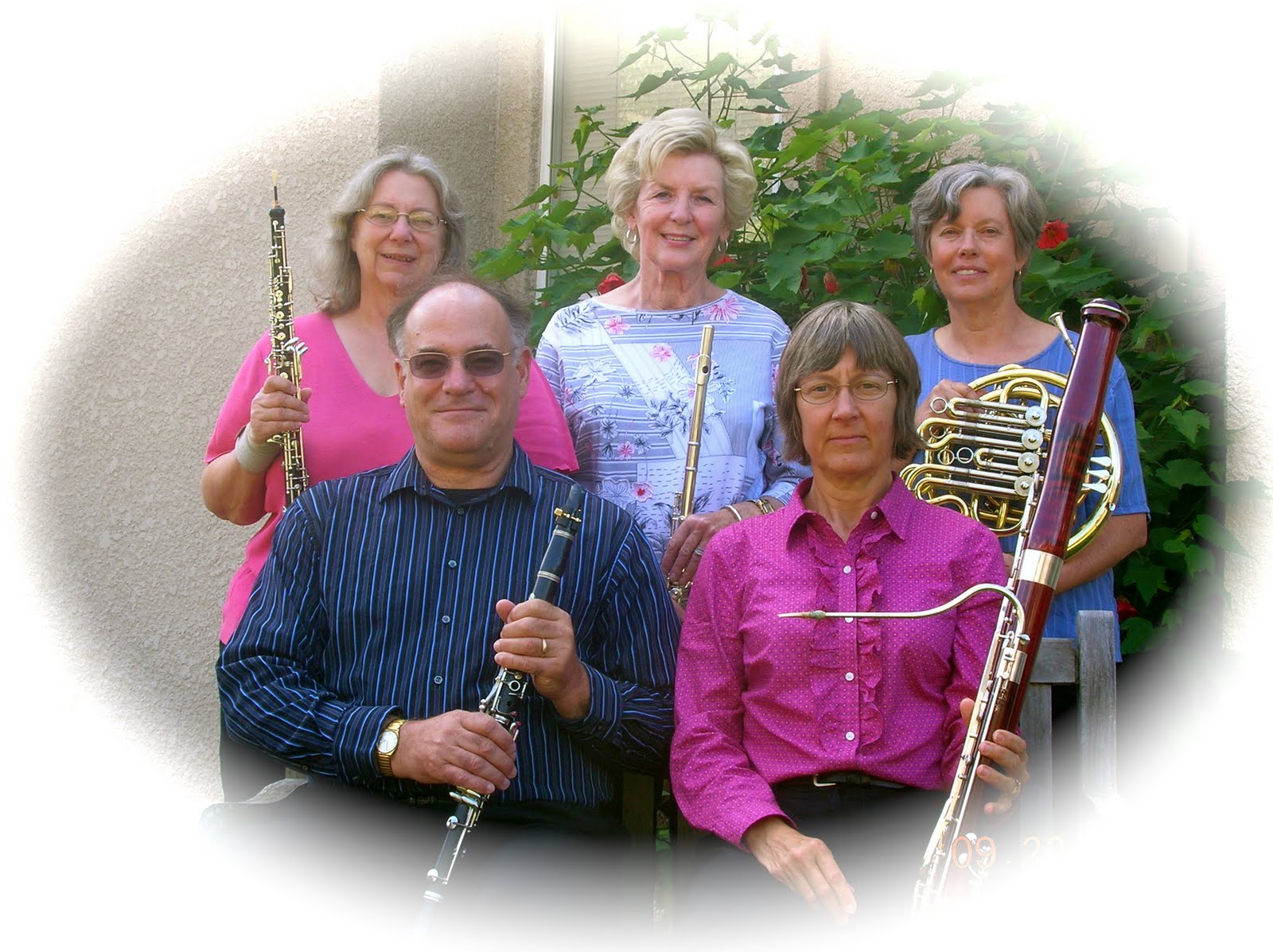
First, I drove to Alameda to the High Street Station to hear the Hillside Quintet, made up of five members of the Castro Valley Chamber Orchestra. They feature flute, clarinet, oboe, bassoon and horn. Their two sets mixed the popular sound of Mozart with the rousing refrains of John Philip Sousa's Liberty Bell March (the Monty Python theme), a surprisingly beautiful composition, the Andante by Muszynski from 1985, and other delightful pieces. They even played "Take Me Out to the Ballgame."

That's the Hillside Quintet in the photo above.

Then, I drove quickly East, to Pleasant Hill, where in the contemporary A-frame of St. Andrew's Presbyterian Church, four separate groupings of musicians (with a few folks playing in multiple ensembles) filled the building with great sounds. After Schubert's String Quintet in C Major (1828) came the biggest surprise of the concert--The Ballade, Pastorale and Dance by Eric Ewazen (born in 1954). In the unusual grouping of flute, horn and piano, it proved, as the Muszynski did, that modern classics can be a delight to the ear.


Sunday, March 13, 2011

Playing Music--it's Good for You

Last night, my band, Red Paint, played a party for a friend of our lead singer's friend. Free food and drink, interesting company, and an OK, if not inspired set.

We played between two sets by a tight blues band called Grease, Grit & Grime. They set up a fine background for the party, which featured beers on tap and a pig on a spit among other attractions.

Today, Sunday, I played my Spring concert with the Castro Valley Chamber Orchestra. It included beautiful music by Mendelssohn, Tchaikovsky and Chopin. The Chopin Piano Concerto No. 1 featured Lois Brandwynne, a brilliant pianist. What a joy to play along with her.

All of my adult music playing began in 2003, when I picked up my electric Fender bass. It was reinforced by starting the upright bass in 2004. Finding bandmates was great, but to play in an orchestra you need help. I found my community orchestra through the Adult School, but there is another way to do it--the New Horizons International Music Association.

I learned about this group in the AARP Bulletin. If you're 50 or over, you can attend one of the sessions and start playing a new instrument--or resume playing the one you gave up after high school. There are about 7,000 members in 182 orchestras, bands and choruses in 41 states and overseas.

Groups meet once a week for an hour lesson followed by playing together for another hour. I have found my two-hour weekly orchestra rehearsals, with concerts every three months or so, to work out perfectly. However, with an orchestra you may need some experience to join, but with New Horizons, you can start whenever you're ready, at whatever level you're at.

It can make all the difference in your life. I know it has in mine.