Showing posts with label Chrysler. Show all posts

Monday, April 22, 2013

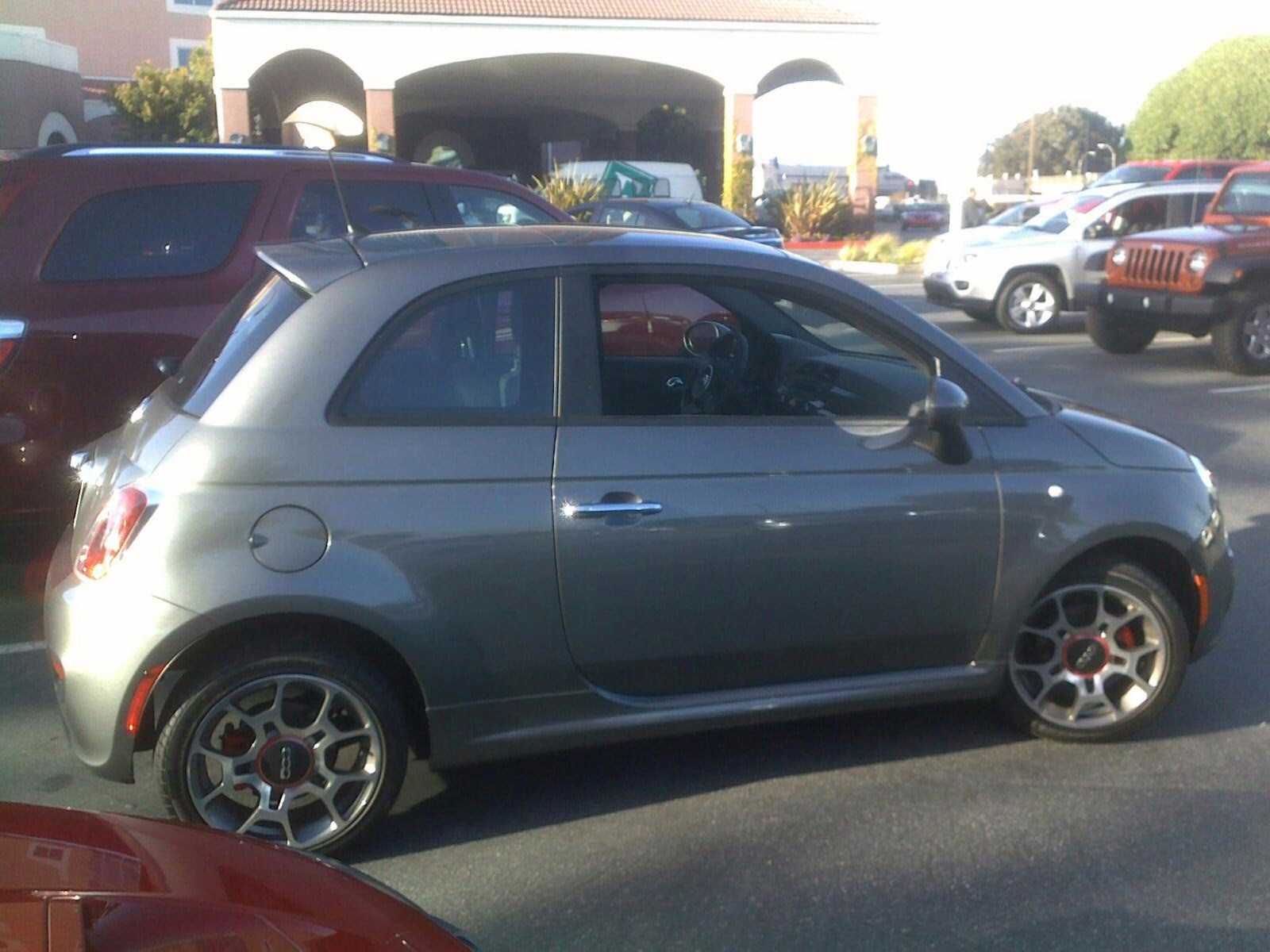
Fiat 500 Abarth - Small but Wicked

The 500 is the first Fiat sold in the U.S. for a long time. It's making its way onto American roads now courtesy of the Fiat acquisition of Chrysler back in the bad old days of late last decade. The cute little bug-like hatchbacks are fun, but not what anyone would consider a sports car.

That is, until the Fiat 500 Abarth came along.

Since the late 1950's, Karl Abarth and his company have turned modest little European cars into rockets and racecars. The 500 is based on a classic tiny 500 from those days, so bringing back the go-fast treatment for the new 500 makes a lot of sense. Thanks to turbocharging and intercooling, the little American-built 1.4-liter MultiAir engine under the pugnosed hood is good for 160 horsepower and 170 lb.-ft. of torque--big numbers when you're talking about one of the smallest cars on the road. Doing the math, that's 117 horsepower per liter!

To support all that extra oomph, the entire suspension is upgraded, with 40 percent stiffer springs and a lower ride height. Other suspension pieces make the car ride and perform unlike the garden variety models.

The Abarth comes with a five-speed manual transmission, built in Italy, that's already been proven in European racing. With its leather-wrapped knob, it sits in a little projection from the cute little dashboard. It definitely adds to the fun.

The dash itself features a leather hood over the instrument panel, with leather stitching. The fat steering wheel, an Abarth design, has grippy leather, a flat bottom, and a big Abarth logo in the center. Actually the word "Abarth" or the graphics are spread out all over the little car's small surface.

Besides the push forward you get when you step on the aluminum pedal cover, the exhaust note reminds you you're not in any ordinary Fiat. It reminded me of when my Honda Civic's muffler rusted off. They call the sound, "menacing." Really.

The accommodations are compact inside, of course, but not uncomfortable (at least in front). The sporty one-piece buckets are appropriately leather-covered and offer serious bolstering to hold you in place. They have racing harness pass-throughs, too, since it's not at all unlikely that you might race the little beast.

To keep you somewhat responsible, there's an upshift light on the left side of the dash. It tells you when to shift up to get maximum fuel economy. Amusingly, it sits in the middle of the turbo boost gauge, which encourages you to drive more aggressively. For more fun, push the Sport button, and the throttle opens up and the steering gets tauter. Also, the Sport button makes the shifting nanny disappear, replacing it with a redline reminder light.

You'd think a small car wouldn't be very practical, but as a hatchback, it's easy to stuff in a week's worth of groceries for the family--and even an upright bass. The tiny shelflet that keeps prying eyes out of the storage in back pops off in a split second, the seats fold, and you've got serious shlepping capacity.

The little 1.4 turbo gets a Smog rating of 5 and Greenhouse Gas number of 8. Fuel economy, per the EPA, is 31 Average (28 City, 34 Highway) -- I averaged 26.6 mpg.

There are cheaper cars of this size, including the 500 in its regular garb, which lists at $16,700. This one starts at $22,700, but with a few nice add-ons, such as automatic air conditioning and upgraded 17-inch white-painted alloy wheels,  the tab can hit $25,000 (my Rosso Red test car was $100 over). All prices include shipping charges.

But it's a pretty loaded vehicle. You get Satellite radio inside,an electronic vehicle information system, Alpine Premium audio, BLUE&ME handsfree communication system, a cool rear spoiler, fog lamps, and lots more. I got a nice thumbs up from a guy driving a "regular" 500 on the bridge. It was part solidarity and part admiration.

Not a silent cruiser, the Fiat 500 Abarth, built in Toluca, Mexico is in-your-face motoring, and if you order the 500c, you can roll back the top and get a better listen to the menacing sound while getting an old-fashioned racer suntan.


Saturday, February 2, 2013

Dodge Dart - Old Name, Brand New Car

2013 Dart - Best Dodge compact in decades.
In the early 1960s, American car companies decided to take on the imports, which were starting to sell more widely. The Big 3 introduced the Corvair (GM), the Falcon (Ford) and the Valiant (Chrysler). In 1963, Dodge got the Dart, based on the Valiant. It was the brand's first successful compact, and was sold through 1975, when it was replaced by the less successful Dodge Aspen.

Following the Dart, Chrysler Corporation compacts have ranged from the VW Rabbit-like Omni hatchback in the late 1970's, the  famous company-saving K cars (Dodge Aries) in the  1980s, the listless Spirit (early 1990s), two generations of Neons (1995 - 2005) and most recently, the ill-conceived and strangely proportioned Caliber.

Finally, Dodge has a credible compact sedan to offer in the 2013 Dart. Why the old name? Apparently it tested well in consumer research with both folks old enough to remember the old Dart fondly and with young millennials--the latter a likely source of fresh sales.

1965 Dart - Yes, I've driven this one, too.
The Dart is the first Chrysler product based on a Fiat platform, in this case the well-regarded Alfa Romeo Guilietta. This means it has something of a European driving feel, but the styling, inside and out, is definitely today's Chrysler. That, I'm glad to report, is a good thing.

The look is soft and smooth--something that's sometimes hard to pull off on a compact car. The front has a floating cross-hair grille to give it brand identity, and the first use of an active grille shutter system, which opens the lower louvers when required for ventilation and closes them when not needed, improving aerodynamics for better fuel economy. The tail can be had with a 152-indirect-glow full-width LED display that comes from the larger Charger. In between, sides flow, with short overhangs, for a planted look.

Inside, the surfaces flow from the doors over the dash, with a carved-out door panels and useful console with a "floating" panel. In my Redline Pearlcoat tester, the black and "Light Diesel Gray" interior wore sturdy cloth. The main dash panel is padded, but some of the other surfaces are grained, hard plastic that doesn't feel especially luxurious. There is a notable shortage of sharp edges and straight lines, which evoked for me a little of the feeling of mid 1990s Ford products. But the cabin felt very comfortable as I settled in and the fairly soft buckets, did a good job.

The Dart comes in five trim levels: SE, SXT, Rallye, Limited and R/T. This means, in plain English, entry level, midrange, luxury and sport. My tester was a Rallye, with about $6,000 in option packages that really upgraded it. I enjoyed using the 8.4-inch touch-screen panel in the center of the dash to control audio, climate, navigation, phone and other settings. With large enough touch areas, it was easy to use quickly, unlike some other electric screens.

Below the screen are basic knobs for audio and climate functions, but I noticed that you could control temperature and fan for the climate, but for deciding where to send the air, you needed the touch screen. It works out well over time. When the phone rings, a prominent spot on the screen makes it easy to answer without much distraction.

The gauges in the instrument panel have white dividers. The speedometer shows 10 mile-per-hour increments (up to a traditional 120 mph) and the tach also features widely spaced lines. I didn't realize that a red line winds its way around them giving five-mph increments--my minor color blindness hid that. The number design is very "Eurotech" for a clean look. A small screen offers fuel economy and other information, which you select using a steering-wheel-mounted button.

You can choose from three engines in the Dart--with a manual or choice of two automatic transmissions. The regular engine is a 160-horsepower 2.0-liter "Tigershark" inline four. My tester had the second choice - a 1.4-liter turbocharged four that also puts out 160 horsepower, and the racer of the bunch, an 184-horsepower 2.4-liter "Tigershark."

The 1.4- and 2.4-liter engines use Multi-Air technology, which delivers optimum combustion at any speed under all driving conditions by allowing direct and dynamic control of air intake and combustion. This means a 15 percent increase in low engine rpm torque and a 7.5 percent improvement in fuel efficiency.

The 1.4 liter turbo in my tester earns solid EPA numbers of 27 City, 37 Highway and 31 combined. I got 27.8 mpg in my driving. That's not extremely high, but the Dart, like its ancestor, is not an econobox, but a compact car with space for real passengers. EPA Green Vehicle Guide numbers are a fine 8 for Greenhouse Gas and a midrange 5 for Smog. This gives it SmartWay status.

The 1.4-liter is not silent in my tester. It had a little graininess, especially during acceleration, but this is not a car meant for serene cruises. It is engaging in a friendly way. I'd like to try a manual-transmission version with the other engines someday to see what the ideal Dart would be. I know that you have 12 color choices and 14 interior color and trim choices, so, like the old Burger King ad, have it your way.

The Dart may have Italian underpinnings, but it's built in Chrysler's Belvidere, Illinois assembly plant. Chrysler sold many Mitsubishi products in years past, but this car, like the Neon, is made in the U.S.

Pricing starts at just $16,790 and go up from there. My Rallye, with a collection of welcome options, came to $24,460, including shipping.

The new Dart is not much like the old one--it's probably better in every possible way. But, as it did 50 years ago, it offers a good choice when you want a comfortable sedan that's neither Spartan basic transportation nor a big car.

Monday, December 24, 2012

Jeep Patriot - An Affordable All American 4x4

The Patriot may be the forgotten Jeep. It is neither the glamorous and highly regarded new Grand Cherokee nor the legendary Wrangler--direct descendant of the heroic World War II four-wheeled life-saver. It may, however, be a car that a lot of people will enjoy owning and driving.

With the all-American Patriot, assembled in Belvidere, Illinois, you get a car that really looks like a Jeep, from the upright, slatted nose with round headlights to the squared-off, protruding wheelwells to the handy roof rails. Its cousin, the Compass, with which it shares a platform, was knocked for looking too soft, but there's no issue with the Patriot. It actually resembles the longtime favorite Jeep Cherokee, which helped to pave the way for compact SUVs in the 1980's.

The three models start with the Sport and move up through the Latitude and at the top, the Limited. Knowing that many people like SUVs for practical reasons but never take them off-road, you can get a Patriot with front wheel drive only. No-one will know that your car is no more of an offroader than a standard sedan, but it could save you some money and improve your fuel economy a bit.

However, you can order two levels of four-wheel drive. My test car, a Latitude model in a handsome Cherry Red Crystal Pearl Coat, had the higher capacity version, known as Freedom Drive II (are you sensing a naming theme here?) Freedom Drive I offers a full-time active system that's nice to have in inclement weather. You can lock the wheels into four-wheel drive for deep snow and sand conditions, but it's really meant for on-road safety, not exploring on the trails. This system, along with seat-mounted airbags, helped earn the Patriot a "Top Safety Pick" rating from the Insurance Institute for Highway Safety (IIHS) for the 2012 model.

Freedom Drive II Off-Road Package adds what you need for some fun in the dirt and rocks. It has a transmission with a low 19:1 ratio crawl gear when it's switched into offroad mode. It also comes with 17-inch alloy wheels and all-terrain tires. You get the skid plates to protect the underside of the car, tow hooks and a full-size spare tire. Best of all, you receive the much honored "Trail Rated" badge. If you're really serious about climbing rocks, though, you will want to upgrade to the extra-rugged Wrangler, but you can't touch it at Patriot prices.

There's a special Freedom Edition Patriot this year. It comes in only red, white or blue and features a star on the hood and rear quarter panel, plus some extra comfort and convenience content. Best of all, Chrysler donates $250 to a military charity for each one sold.

Patriots come with one of two engines. The standard engine in the Sport and Latitude levels is a 2.0-liter four that puts out 158 horsepower and 141 lb.-ft. of torque. With a five-speed manual transmission, you can get  a remarkable 30 miles per gallon on the highway. The five-speed manual comes only on the Sport. When you step up to higher levels the continuously variable automatic is standard.

Standard on the Limited and optional on the other models is the 2.4-liter engine with 172 horsepower and 165 lb.-ft. of torque. You'll lose two mpg on the highway compared to the 2.0-liter, but the extra power should be welcome in daily driving.

The EPA gives the Patriot with 2.4-liter engine and automatic ratings of 21 combined (20 City, 23 Highway). I got 18.7 mpg in mixed driving.  The Green Vehicle Guide numbers are 6 for Air Pollution and 4 for Greenhouse Gas (2012 model). Obviously, there are vehicles with better numbers than this--and some that are worse. 

Thanks to dual variable-valve timing, the engine makes the most of the torque curve for higher performance. My tester had this engine and it seemed eager to get up and go, although I didn't take it on any rock climbing expeditions.

Like pretty much every car that has levels, the Patriot gives you more when you  move up. The Sport has a lot going for it already for its low price, including the safety of electronic stability control and hill start assist and conveniences like cruise control and an outside temperature display. The Latitude, as the middle and likely most popular level, throws in power windows and locks, air conditioning, keyless entry, heated seats, and niceties such as a leather-wrapped steering wheel and a 115-volt power inverter. The Limited, of course, is where you get leather seats with power adjustment, an electronic vehicle information center, a nice audio system with SiriusXM, climate control, and all the trimmings.

The Patriot wasn't as nice when it debuted for the 2007 model year, but over the last few years, new ownership has put money and effort into upgrading every vehicle sold by Chrysler. The inside of the Patriot, while not luxurious, feels well crafted and substantial. Pieces fit together well. It's really a baby Grand Cherokee more than just the least expensive 4x4 sold in America.

This is a highly affordable choice in the compact SUV market. Prices for a manual-equipped Sport with no options start at just $16,920--a remarkable number indeed. My Latitude tester with four-wheel drive and some audio upgrades came in at $26,220.

My only concern about Jeeps is their tendency to not be highly favored by the sharp-eyed folks at Consumer Reports, although reliability ratings are above average. It's likely that the vehicle's age is a factor here, but sales of Jeeps are up--so plenty of folks still want to own one.

Many changes are on the way for Jeep, including a new small SUV based on a FIAT platform. But for the real all-American four-wheeling deal, this is a very reasonable way to take it to the street--and off the road.


Wednesday, October 17, 2012

Chrysler 300 - A Fitting Flagship

The Chrysler 300 has been good for Chrysler, and, renewed back in 2011, it has helped return some prestige to the brand.

The 300 series goes all the way back to the 1950's, when the potent Hemi V8 engines were part of the explosion of power and fins that defines that age for us today. The 300 name died out in the mid 1960s, but in 2005, it was brought back to define a new kind of car for Chrysler. After the handsome, softly rounded "cab forward" sedans of the 1990s it delivered a chunky, traditional feel, more like a Rolls-Royce than the designs that preceded it.

I remember, at the time, being surprised at the upright windshield and the high window line. Of course, that high window line has become "normal" for cars now--just look at the latest Ford Taurus--one of many vehicles to follow Chrysler's lead. The 300 was based on a Mercedes-Benz E-Class platform, so it was as solid as it looked.

What to do with the new 300? With the company's revival under Fiat leadership, it got the full beauty treatment. The shape remains, but the windshield is a little bit more reclined, and the surfaces, once edgy and brash, are softly shaped and subtly upgraded. The blocky taillamps now have a gentle curve and edge along their lenses and the deep indent in the lower trunk is minimized. Up front, the once jutting grille is more smoothly integrated, using the marque's slightly angled chrome bar theme.

Inside, time and money have been well spent. A dual-pane panoramic sunroof in my Luxury Brown Pearl Coat 300C tester brought light to the elegantly appointed surfaces. My top-of-the-line model had an impressively thick wood and leather steering wheel--heated of course. The 8-inch screen in center dash was easy to see and use, feeling almost like the interface of an iPad, with touch buttons along the bottom for easy access to the multiple facets of the system.

The real wood steering wheel toned in with the wood trim in the car itself, although I think the trim was not from a real tree. The center console, with its roll-top cover (like a fine old desk) was elegant--although I kept it open most of the time to hold coffee mugs, notebooks, and so on.

The dash panel is one area that really got the love in the new model. It's a deco wonderland of chrome and soft blue lighting worthy of Busby Berkeley or your favorite Art Deco building. Considering that you look at the dash for the whole time you're driving, it makes sense to pour on the pleasantness there, doesn't it?

The seats, covered in my tester in light brown, soft leather, were very comfortable--neither too soft nor too firm, although I'd place them on the softer side of medium. The illuminated door handles added another touch of something special.

Chrysler 300s come with a range of engines. My 300C boasted a mighty 5.7-liter Hemi V8, putting out 363 horsepower through a five-speed automatic to the rear wheels. All-wheel drive is available, too. The Hemi hauled the 4,300-pound car nicely and with very little sound. This is the right feel for a car meant to evoke those Eisenhower years. But, you can also equip a 300 with a 3.6-liter, 292-horsepower V6, which, with its first-in-segment eight-speed automatic, is good for 31 miles per gallon Highway per the EPA. My car was rated at 16 City, 25 Highway (19 Average); I achieved 17.9 mpg in my heavily-commute-oriented week.

The EPA's Green Vehicle Guide numbers for the 300 are 6 for Air Pollution and 3 for Greenhouse Gas.

The car, despite its impressive stance, proportions, and poundage, drives remarkably nimbly. There's some road feel through the steering wheel, and the steering is reasonably assisted, not flaccid at all. Despite being accused of looking like a "gangster" by a colleague, I was actually pretty content inside the 300.

Just because the car's a little retro doesn't mean it's not totally with the second decade of the 21st century. My car had Customer Preferred Package 29T, which includes a parking assist system so you don't need to scrape those lovely 20-inch alloy wheels. The headlamps level themselves automatically. Adaptive cruise control keeps the distance between you and the car ahead and warns you if you approach the car ahead too quickly (even when not using cruise control). I had one instance of seeing "BRAKE" flash at me from the instrument panel when someone stopped suddenly in front of me on the freeway.

Blind spot and cross path detection works like a sentinel to keep you informed of when someone is potentially in your way so you can take defensive action.

I heard things in the optional audio system that I had never noticed in tracks off the iPod I had plugged in and stashed in the center console. With 19 speakers and 900 watts of power it was like few I've experienced.

What kind of price would you expect for this kind of a ride? Well, how about $46,300? Sound like a lot? Look at the list of goodies. It does have its work cut out for it in the competitive luxury sedan market, but it could change some minds about buying North American (it's built in Ontario, Canada). Other than one slightly misalligned trim piece, it looked sharp and tight from one end to the other.

You can pick up a 300 for as little as $30,840 if you like the style but are put off by the price.

Tuesday, September 4, 2012

Dodge Dart - 1965 Model a Flash from the Past

With the all-new, Alfa-Romeo-based 2013 Dodge Dart out and on the road, it felt like a good time to test the original Dodge Dart. Luckily for me, I have a friend, Elena, who owns a beautiful example of the first compact Dart--a glorious and powerful 1965 Dart GT. She let me drive and photograph it on a recent summer day. She then sat down to tell me why she bought it.

I have personal connections to the Dart, as my mother had one back in the late 1960's. Our 1966 baby blue Dart convertible was a fine cruiser, with its durable slant-six engine, three-on-the-tree manual and power top. We also had a 1966 Plymouth Valiant before that--a close Chrysler cousin to the Dart--and the car in which I passed my driver's test (on the first try).

The original 1960 Dart was a full-size car, but it became a midsize in '62 for one year before taking the place of the original Dodge compact--the Lancer--in 1963. It remained a popular vehicle, in sedan, coupe and wagon form, until it was replaced by the Dodge Aspen in 1976. The latter car proved to be a disappointment. Until the 2013 Dart arrived, the compact position at Dodge has been a tough job, filled by the famous "K car" Aries) in the 1980's and others such as the late, unlamented Neon and Caliber.

Elena's '65 GT is a fine driver, looking great from 15 feet. It has not been meticulously restored, and shows minimal changes since its birth during the Johnson Administration. Presumably a repaint, it still looks authentic inside and out. A compact car in its day, it is safely midsize by today's reckoning, and when you're sitting on the big bench seat inside, it feels like a huge car. I figured out why. Besides the gentle rocking motion of the old-fashioned and simply old suspension, I could see the entire hood--and it was as big as a pool table out in front of me through the windshield. The uplevel GT model has chrome trim along the fenders ending in a tiny fin at the corner. Today's more aerodynamic cars, for the most part, show you nothing ahead of the windshield.

Grab the chrome door handle and swing open the heavy metal door. Then, you'll see mid-sixties design in all its glory. With the more fanciful, swoopy 1950's relegated to the past, the sixties cars showed more restraint, especially Chrysler, where designer Elwood Engel, known for the early 60's Lincoln when he worked for Ford, brought a rectangular Danish Modern effect. The silvery, flat dash features separate rectangles for the auxiliary gauges and a flat glovebox door. The gauges included a gas gauge but also a temperature and alternator (electrical) gauge. Today's cars feature "idiot lights." The look isn't flashy, but it's easy to live with and durable.

The steering wheel is big, thin, and hard, and wears a chrome horn ring in its center. No airbags here. In fact, this '65 doesn't even have shoulder belts. The seatbelts fasten like those in today's airplanes. What a nostalgic moment to reach back and find--nothing. There are no neck-saving headrests on the seats, either. You are at much greater risk cruising in this tank.

This is the 1960's. I found small ashtrays in both front armrests and in the center console. They had not been used recently. The dash-mounted lighter remained--today's cars supply them to power portable electronic devices, such as navigation systems. And, of course, there were manual crank windows--even in the top-level Dart.

But what a feeling. The Dart GT, as the sporty model, features a floor-mounted automatic transmission lever and under the hood, a 273 cubic inch (4.5 liter) V8 engine, good for 180 horsepower with a two-barrel carburetor. A more powerful V8, good for 235 horsepower, was also available starting in 1965. The highly-regarded and reliable slant six in the lower level 170 and 270 series generated either 101 or 145 horsepower, depending on whether you ordered the extra-cost version ($50).

This engine in my test car was recently steam cleaned and it looks sharp with its clean, spacious layout freed of today's electronics and smog management technology.

After I stepped in to drive the car and buckled up, I inserted and turned the tiny metal key. It's main part is shaped like the Chrysler pentastar--I remember it from our old family cars. Car keys used to look like your house key before they became the large black plastic electronic gadgets they are today.

The Dart started right up and off we went. With the V8, there was plenty of power, but it sounded much different from recent V8s I've driven. The ancient brakes were effective but you had to really press the pedal. I'm guessing they were drums and not discs. Of course there is no antilock or other high tech assistance available.

The Dart was meant to give Americans comfort and familiarity in a smaller (but not tiny) package, so the car drives much like a full-size Dodge Polara would, meaning it floats a bit, noticeably upon starting, stopping and turning--in other words, most of your driving time. Once the engine warmed up, though I heard very little as we zipped around Elena's surburban neighborhood and took a quick trip on the freeway. Cruising is this car's strong suit, and I'd gladly do so again.

So, why does a person want to drive a nearly 50-year-old car? And why this one? Elena told me she had owned a 1967 VW Bus and had a boyfriend who had a 1960 Corvette, so she fancied some kind of collectible car.

She found the Dart locally on Craigslist. Why a Dart? "It picked me," she says. She liked the looks and the handsome, original interior. And apparently the owner had cared for it pretty well. She has had the Dart for only a short time, but has had no significant problems with it.

That being said, as we returned to Elena's house, a man in a Chrysler PT Cruiser waved to us. We rolled down the window and he said, "Your brake lights aren't working." It's always something--but the charm of old vehicle ownership seems immune to the pains of maintenance, as long as you can drive and enjoy the car.


Saturday, August 18, 2012

New Dodge Dart Arrives -- with a Great Ad

The new Dodge Dart is here, and however good the car may prove to be--or successful--it has great advertising putting the word out. That link in the last sentence takes you to a story on the agency that crafted it--and gives you direct access to view the 90-second spot for yourself.

You'll want to run it a couple of times. From the "American" on the pencil to the "tweak, tweak, tweak" it's a grabber.

My wife called me in to look at the new ad and it's funny, and makes a point. This is a car that's been carefully planned, styled, and has all the right stuff. And this is one very important vehicle for Chrysler. It's the first Chrysler, Dodge, Ram or Jeep product to use an Italian platform, which means it's the real beginning of the new Chrysler Corporation. It competes in the hot compact sedan segment against everything from the Ford Focus to the Chevy Cruze to the Toyota Corolla and Honda Civic. From here on, more Fiat and Alfa-Romeo platforms will be under cars you get at Chrysler/Dodge/Jeep/Ram/SRT dealerships.

I drove a Dart recently for a few minutes and it seemed competitive. I'll have to spend a week with one soon to get the whole story, but you can cruise down to your local dealershop now. Do it. And watch the ad.


Wednesday, June 6, 2012

New Dodge Dart is the Real Deal

2013 Dart - 1965 model in background
I had a chance tonight to see, touch and drive the new Dodge Dart.Yes, it's a name from the past, but Chrysler's research showed that the moniker was a big hit with both target demographic groups--empty nest boomers who remember the nameplate fondly and young millennials who have positive associations with the word without a memory of the reliable 60's and 70's compact. So, that's the name the car received, apparently just before it debuted.

Our press opportunity was graciously provided in an exciting and amusing venue--Sparky's Hot Rod Garage in San Carlos, California. Amid the hot rods (Sparky started up one for us with a deafening roar), hilarious period signage and mysterious rows of mounted deer heads, we learned a lot more about the first car to combine Fiat's European engineering with American design and planning.

First, we got to take short drives in the two demo vehicles. I sampled a Limited model with an automatic transmission. This is the second highest of five levels, which range from the entry SE through the volume-seller SXT to the performance-oriented Rallye. A fifth, higher-powered R/T model will arrive later this year. The car itself is due to start trickling into Chrysler dealerships later this month.

Some fun was added by the presence of a lovely 1965 Dart coupe. The new and old cars hardly resemble each other at all, but their mission remains the same--to deliver some style and performance in the compact segment of their day's car market. It's just that today, the '65 would be considered a midsize car--not a compact. See the photo for a shot of them together.

We were lucky to have four Chrysler folks presenting the car--the PR Manager, Media Relations Manager, Senior Manager of Product Planning, and Platform Engineer. All four were thorougly knowledgeable and gave us a lot of insight into how the American designers took the Alfa Romeo Giulietta and stretched and modified it for U.S. consumption, giving enormous passenger room with the comfortable, yet firm suspension American drivers prefer. We heard about three engine choices, three transmissions, 12 exterior colors, 14 interior  color and trim combinations, and much more to let the buyers configure their Dart to their exact liking.

Taking the car on the road, I was impressed by its solid feel, tight steering and near silence as it flowed down the road. All Darts should average more than 30 miles per gallon. I'd really like to sample the 1.4-liter turbo model with the manual six-speed transmission.

The sweet Italian platforms offer evocative, but restrained styling and a feeling of quality interior fittings (only a little cheap-looking plastic on the center console).The new Dart is built in Belvidere, Illinois, too, bringing employment and pride to that longtime Chrysler assembly plant.

Even the most basic SE model, at $16,790, including shipping includes things like 10 airbags, four-wheel disc brakes, and power windows. The Limited starts at $20,990, but it includes many extras that people like. The SE gets the 2.0 liter 160-horsepower engine, which should be OK. The 1.4-liter intercooled, turbocharged engine is mightier, and the R/T gets the 2.4-liter, with 184 horsepower. So many choices.

The MultiAir technology tosses out the camshaft and gives electronic control to the intake system, meaning it can run extremely efficiently. Chrysler hasn't had the resources to develop and sell hybrid or electric vehicles, but MultiAir brings conventional power-plants up near hybrid or electric levels--without the complexity and limitations of the super green cars.

The body and interior obviously received lots of attention to let buyers know--this is no Neon or Caliber. This is a real car--with all the quality and style of a larger vehicle. The car has aerodynamic aids throughout for a low coefficient or drag, which, of course, leads to higher fuel economy and a quieter cabin. The Chrysler folks pointed out many areas where wind noise was banished. There are body pans to smooth the wind's path. On most models, the grille shutters down to increase efficiency of airflow under certain conditions.

The game has just become much more interesting. A lot is riding on this vehicle, and the folks from Chrysler are quite proud of it.

Monday, December 19, 2011

Saab - RIP

Saab has filed for bankruptcy, so it looks like it won't survive much longer.

A lot has been going on with the company since GM sold it off in its own bankruptcy proceedings in 2009. There had been been hope of a Chinese white knight to somehow take on the daunting challenge of restoring profitability to the Swedish automaker, but it looks like time and interest has run out. That solution has worked, for the time being, for the other Swedish brand, Volvo.

It's sad, and it's not the first brand I've known all my life that has gone. I've seen all of America's "Big 3" shed brands -- Plymouth, Oldsmobile, Pontiac and Mercury are now defunct, and Saturn, the newest GM brand, lasted only 20 years.

This kind of change happened in the 1950's, which saw many independents, such as Nash, Hudson, Packard and Kaiser, fade into history. Studebaker, which predated all the car companies in being a wagon manufacturer in the 19th century, held on until 1966.

What's happening today shows broad changes in the highly competitive auto industry and although it's too bad, it's also a necessity for the overall car business to thrive. Growth is definitely happening in the Korean companies, Hyundai and Kia, so although there are now fewer brands from the major US companies, there are still lots of choices.

Saab made a lot of interesting cars -- many are still out there in traffic -- and, when, as it looks nearly inevitable, it passes into history, it will not be soon forgotten. That's the latest 9-5 in the photo.

I've never owned a Saab, but I've driven some, including a bright green convertible. I do have a Plymouth and a Nash. Maybe it's time to add a Saab to my collection.

Friday, December 9, 2011

Dodge Dart is Back!


The New Chrysler has been short of a compact sedan. But soon, that problem will be elegantly solved with the all-new 2013 Dodge Dart. The car will debut at the Detroit Auto Show one month from today.

If the name sounds familiar, that's because it is. Dart was introduced as a version of the full-size Dodge back in 1960, but it was the ground-breaking 1963 compact model that made it was it was. That car, after changes in 1968, ran into the mid 1970's and featured an economical and bulletproof "slant 6" as well as some mighty V8s, making it popular for the modest and the manic.

A 1966 model is pictured. I learned to drive on the Plymouth Valiant of the same year--it's corporate cousin--and later drove my mother's 1966 Dart convertible--a baby blue beauty with "three on the tree" manual transmission and black vinyl interior.

The 2013 is shown in teasers like the red one posted here. It's based on an Alfa Romeo and promises to be handsome and a fine driver. Three efficient four-cylinder engines, including one with a turbo, should, like the early Dart, provide a choice of driving experiences.

The new Dart will be built in the updated Belvidere, Illinois plant that has produced compact Dodge and Plymouth Neons and other models for Chrysler since it opened in 1965.

I hope they offer one with a manual transmission!

Wednesday, March 30, 2011

New Chrysler Looks Good So Far

I am just finishing up a weeklong test of the 2011 Jeep Compass. Like its Chrysler Corporation brethren, it has been significantly improved this year. And the improvements, as far as I can tell, are real.

How do you judge a car? Consumer Reports supplies data on number of defects per 100 cars, but you only have one. It's how the car feels when you're sitting inside it and how it drives. In these two ways, the 2011 Compass is worlds better than the one I tested four years ago.

For one thing, the face is much more attractive. The hood, fenders and fascia resemble those of the new Grand Cherokee, which has been hailed by practically everyone as a milestone vehicle for the brand. It's like getting a nose job from the top surgeon in Beverly Hills.

Inside, the dashboard is not only better looking, but seems to be constructed of significantly upgraded materials. The plastic has a fine sheen to it. The doors are nicely padded. The trim looks great--especially on the steering wheel, which is elegantly presented and contains controls for the audio and trip computer, among other things. The seats are handsome and comfortable. The window control buttons feel nicely rounded. And--it's quiet in there.

Chrysler's Media website claims they've fixed the steering and suspension, and it must be true because the car's a joy to drive--a real surprise for me. Apparently they dialed in a higher spring rate, improved damping, and added rebounding springs, as well as beefing up the sway bar.

I got more than 20 miles per gallon, too, from the 2.4-liter four with continuously variable transmission.

At $26,000, with a bunch of extras, I was impressed. Next: Let's see what they did to the new Dodge Charger!

Wednesday, March 9, 2011

WAJ Media Days--Great Fun

From Monday night to Wednesday afternoon, I spent many happy hours in Monterey at the 19th Annual Western Automotive Journalists Media Days.

Besides the great opportunity to drive a wide selection of the latest cars on local roads and at Mazda Raceway Laguna Seca, it was a chance to reconnect with with my automotive colleagues and favorite industry representatives.

Highlights for me this year included:

  • A special presentation from Chrysler, who brought samples of all of their revamped products as well as the new Dodges, Jeeps and Fiat.

  • A chance to drive local roads, some winding and scenic, in the long-awaited new Fiat 500 (pictured) as well as the Volvo S60, 2012 Ford Focus, Cadillac CTS Coupe--with a manual six-speed, BMW 335is, Chevrolet Volt plug-in hybrid, Honda CR-Z manual-equipped hybrid, and the Mitsubishi i-MIEV and smart battery electric vehicles.

  • A busy track day with a selection of great vehicles including the MAZDASPEED3--which was just as much fun as it is on the road--and the surprising Buick Regal Turbo--with a manual six-speed! The Subaru WRX STi was marvelously tenacious on the curving racetrack. Even the Volt was OK on the track--running only on electricity.

  • There was an impromptu drag race between the smart and the i-MIEV to see who the best electric was--the i-MIEV won.
  • The Hyundai Equus impressed me with its amazing luxury--like a Lexus for less money--incredible.

  • Many tasty meals, including the usual banquet on Tuesday night.

The weather was incredibly good, considering the date. I wore a T-shirt outside both days.

Tuesday, February 15, 2011

What's Your Automotive Quotient (AQ)?

For an amusing and informative 20 minutes or so, go check out Carl, the tattooed animated crash-test dummy. I found him in the pages of Automotive News, but you can go here to play his fun automotive question and answer game.

I know a lot about cars, but I didn't get them all right. For example, do you know when the first paper speeding ticket was issued? Go find out.

The purpose of this bit of motorized frivolity? To call attention to Chrysler's certified used vehicle program.