Wednesday, October 31, 2012

Infiniti M56 - Performance. Luxury. Technology.

Infiniti, the upscale division of Nissan, has presented various interpretations of upscale transportation throughout its two decades of existence. The M sedan is today's halo car, with a pleasing blend of performance, luxury and technology. Style and craftsmanship are the mortar between those three bricks.

Just listing the amazing array of features on this midsize BMW/Mercedes/Audi/Lexus competitor would take up more room than I have, so we'll have to look at some representative examples.

Performance is a great place to start. There are two available engines--the 3.7-liter, a 330-horsepower V6 found in the M37 and the mighty 5.6-liter V8, with 420 horsepower and 417 lb.-ft. of torque, that sits beneath the curvaceous hood of the M56. Both engines come mated to a seven-speed automatic. The car comes standard with traditional rear-wheel-drive but you can request the Intelligent All-Wheel-Drive system if you are concerned about traction.

My 2013 M56 was rated at 16 City, 24 Highway, with an average of 19 mpg by the EPA. I accumulated 17.1 mpg--not bad, but premium fuel was running nearly $5.00 a gallon during my test. The 2012 model earned a 6 for Air Pollution and 3 for Greenhouse Gas from the EPA. Big engines have trouble getting a good Greenhouse Gas score, but you can carefully control an engine of any size for low emissions.

Luxury is both a look and a feel. What other motorists see is a bold, curvilinear design that has borrowed something from classic British Jaguars and Bentleys but is comfortably informal too. It's almost prettier than you expect, and it's comforting to look out the windshield at the sensuously proportioned hood. My tester was a Platinum Graphite M56--a formal gray that fits for a car of this caliber.

Luxury is best represented inside, with sublime leather seating, Japanese Ash trim and the long list of amenities that are expected at this price point and market segment. Yes, there's dual-zone climate control, but this car has something even better--Forest Air. As part of the Sport Package (more on this later), it removes odors and then distributes the breeze in an irregular, outdoorsy way. Oddly, when it's  varied like this you are actually more aware of it.

Technology may be the most important ingredient in this super car. A rear-view monitor is nothing that special today, but how about a rear sonar system that detects objects? You have access to the Zagat restaurant guide through the Hard Drive Navigation System, along with traffic and weather information. Rain sensing windshield wipers are no longer a new idea but they fit right in here, along with automatic on-off High Intensity Discharge headlamps.

If you really want technology, though, you have to order the $3,050 Technology package. Here you get a blind spot warning system that tells you, with lights, when someone's next to you where you can't see them in your mirrors. The next step is Blind Spot Intervention, where the rear brakes automatically kick in to guide you away if you try to turn into an occupied lane.

If no-one's there but you need to stay in your lane, the Lane Departure Warning and Lane Departure Prevention systems are there to protect you. Active Trace Control fine tunes engine torque and four wheel braking to keep you poised on curving roads. Forward Collision Warning is part of the braking package that lets you know with flashing lights if you're coming up too quickly on someone in moving traffic. My least favorite part of the Technology Package was the Eco Pedal, which pushes back at you if you drive too vigorously. I'm glad to save gas and the environment, but that's too much nannying.

Further enhancing my tester was the Sport Package ($5,650) that introduced stunning 20-inch wheels to go with lots of "sport" features, such as the Sport front fascia (dark instead of chrome), Sport brakes with four pistons in the front disc and two in the rear. How about Sport seats in front? A Sport-tuned suspension? Four wheel active steering sounds pretty exotic--and Nissan/Infiniti has experimented with it for a while. It just enhances the feeling of agility of this two-ton ride.

Craftsmanship? The pieces fit together perfectly, the materials are top-level and there is such a wealth of things to look at and touch. It's hard to think of anything that could be missing here. The side panels are made of aluminum to save weight, but are hand-inspected to be perfect. You won't get that on a Nissan Sentra.

You'll pay for the privilege of driving an M56. It starts at $61,100, and when you add in the $895 shipping charge you're touching $62K. With the Technology and Sport packages, the bottom line for my car was $70,195.

However, driving a car like this puts you in a different frame of mind. Everything is so lovely, so comfortable and so silent (they even have Active Noise Control, which counteracts engine, road and wind noise). You feel more relaxed in stop-and-go commuting. It feels good to move your eyes and hands over the swirling, exuberant trim and pieces inside. I often found myself feeling the armrest, the steering wheel, the dash, the console.

It's been a long haul for Infiniti--they haven't been the sales star that Lexus has been--but they definitely have found their way today and offer a beautiful alternative to the other upscale four-wheeled choices.


Sunday, October 21, 2012

Ford C-Max -- A Prius Alternative

The Toyota Prius has been successful partly because it offers something better--and is now an iconic presence on the road. Even people who don't own one or have even been in one know that a Prius is a hybrid that gets great mileage and is environmentally friendly.

Well, who says the Prius has to have all the attention? Ford has offered numerous hybrid alternatives, most notably the compact Fusion sedan and Escape SUV, but those cars look almost exactly like the gas-only versions and can't match the Prius' posted 50 mpg.

Ford has decided to build the Europe-designed C-Max in Wayne, Michigan. The C-Max is a compact but tall four-door hatchback, and will sell only as a hybrid in the U.S. And it not only looks like a member of the new Ford family--it stands apart as a hybrid only. Now the marketing people can take over and create a recognizable brand.

It's a very nice vehicle, as I discovered with a week of driving one. My Blue Candy Metallic Tint Clearcoat SEL model had the feel of a new car but also the familiarity of what a hybrid is supposed to be. The side window line was pretty close to a Prius, I have to admit, but the nose has the new Aston Martin" grille appearance--although it sits low on the prominent plastic bumper, close to the road. 

The real point of a hybrid, of course, is to get high fuel economy and drive clean while you're doing it. There may be a bit of "hey, look at me, I'm driving a hybrid," too, and Ford's high-tech screen actually thanks you for driving a hybrid!

Like a good hybrid should, the C-Max mates a 2.0-liter four-cylinder engine and an electric motor to make your fuel fill-ups take you further. The Prius has made a point of showing you a screen of wheels turning and where the energy is coming from and where it's going. The C-Max doesn't, but has a coach to guide in in driving intelligently. It shows you how much power is in the battery and displays when you're charging it by regenerating power while braking. It even tells you the percentage of energy you regenerated. One screen on the highly-configurable MyFordTouch instrument panel lets you grow leaves with your good driving behavior.

The airy cabin is welcome--and a buyer expectation from dedicated hybrids. The windshield goes way forward and there are little triangular panes in the substantial pillars. The various angles and surfaces in Ford of today are always moving your eyes around the cabin, so you don't get bored. The tall ceiling also lends a sense of connection with the outside, but you won't hear much from there. And, when the car's using the electric motor only, it's blissful silence.

Ford's SYNC system is a fascinating look at the future (and some might even say the present) of automotive technology. The problem is, it's frustrating to use. I spent substantial time testing the voice commands for the audio system, navigation system and climate control. I asked for an artist and sometimes got the wrong person. I set up a destination via voice and the car actually took me to the wrong address.

But when it worked, it was satisfying, and even when the system let me down, I kept going back for more. It discovered that it works a lot like software, in that you need to move from one screen to another, systematically. It would be great if the system understood a sentence and didn't need to be fed a series of commands, such as "Audio > USB > Sirius > artist > song." Ford has taken a hit for confusing and confounding its buyers, but this is exciting--even if it feels like we drivers are working as Ford's beta testers.

The car is listed by the EPA as averaging 47 miles per gallon (and the same for City and Highway ratings). Sadly, with my long stop-and-go commutes and in-town driving, I averaged just 37.9 mpg over my test week. That's actually great--and better than virtually any other car I've driven, but the Prius does better and the sticker said 47.

Perhaps it makes more sense to compare the C-Max to the new Prius V, which is more wagon-shaped. My test of a 2012 Prius V recently came up with 38.8 mpg--pretty much a wash.

The Prius has never been been renowned for it's sporty driving experience despite its undeniable competence at everything else. That may be the Ford's biggest selling point. The car handles tautly, and feels more alive on the road. Of course, you're up high, so it's not like a sports car, but the steering is more direct than the Toyota and the engine feels responsive.

At this point, C-Max models include the SE and the SEL, but a plug-in hybrid model is coming soon. Like the Prius Plug-In, it offers fuel-free motoring for a limited distance and you can charge it with a plug and cord to make that happen. For folks not intending on traveling major distances routinely, it could offer the advantages of an all-electric car with the freedom to add fuel and take off for wherever you want.

Prices for a C-Max SE start at $25,200. The SEL, with additional content, starts at $28,200. My car had a $3,080 optional equipment group that included Premium Audio and Navigation, a power liftgate, keyless entry, the high-tech parking technology package, and the charming and aggravating hands-free technology package. Like a Prius, the price range starts out fairly reasonable and moves into entry luxury territory in a hurry.

The C-Max is a new entry in the American car market, and seems to have the right ingredients. Perhaps passing on the SYNC voice interaction would be a good plan, but for hauling your family and gear--with some driving satisfaction--it seems poised for success.


Wednesday, October 17, 2012

Chrysler 300 - A Fitting Flagship

The Chrysler 300 has been good for Chrysler, and, renewed back in 2011, it has helped return some prestige to the brand.

The 300 series goes all the way back to the 1950's, when the potent Hemi V8 engines were part of the explosion of power and fins that defines that age for us today. The 300 name died out in the mid 1960s, but in 2005, it was brought back to define a new kind of car for Chrysler. After the handsome, softly rounded "cab forward" sedans of the 1990s it delivered a chunky, traditional feel, more like a Rolls-Royce than the designs that preceded it.

I remember, at the time, being surprised at the upright windshield and the high window line. Of course, that high window line has become "normal" for cars now--just look at the latest Ford Taurus--one of many vehicles to follow Chrysler's lead. The 300 was based on a Mercedes-Benz E-Class platform, so it was as solid as it looked.

What to do with the new 300? With the company's revival under Fiat leadership, it got the full beauty treatment. The shape remains, but the windshield is a little bit more reclined, and the surfaces, once edgy and brash, are softly shaped and subtly upgraded. The blocky taillamps now have a gentle curve and edge along their lenses and the deep indent in the lower trunk is minimized. Up front, the once jutting grille is more smoothly integrated, using the marque's slightly angled chrome bar theme.

Inside, time and money have been well spent. A dual-pane panoramic sunroof in my Luxury Brown Pearl Coat 300C tester brought light to the elegantly appointed surfaces. My top-of-the-line model had an impressively thick wood and leather steering wheel--heated of course. The 8-inch screen in center dash was easy to see and use, feeling almost like the interface of an iPad, with touch buttons along the bottom for easy access to the multiple facets of the system.

The real wood steering wheel toned in with the wood trim in the car itself, although I think the trim was not from a real tree. The center console, with its roll-top cover (like a fine old desk) was elegant--although I kept it open most of the time to hold coffee mugs, notebooks, and so on.

The dash panel is one area that really got the love in the new model. It's a deco wonderland of chrome and soft blue lighting worthy of Busby Berkeley or your favorite Art Deco building. Considering that you look at the dash for the whole time you're driving, it makes sense to pour on the pleasantness there, doesn't it?

The seats, covered in my tester in light brown, soft leather, were very comfortable--neither too soft nor too firm, although I'd place them on the softer side of medium. The illuminated door handles added another touch of something special.

Chrysler 300s come with a range of engines. My 300C boasted a mighty 5.7-liter Hemi V8, putting out 363 horsepower through a five-speed automatic to the rear wheels. All-wheel drive is available, too. The Hemi hauled the 4,300-pound car nicely and with very little sound. This is the right feel for a car meant to evoke those Eisenhower years. But, you can also equip a 300 with a 3.6-liter, 292-horsepower V6, which, with its first-in-segment eight-speed automatic, is good for 31 miles per gallon Highway per the EPA. My car was rated at 16 City, 25 Highway (19 Average); I achieved 17.9 mpg in my heavily-commute-oriented week.

The EPA's Green Vehicle Guide numbers for the 300 are 6 for Air Pollution and 3 for Greenhouse Gas.

The car, despite its impressive stance, proportions, and poundage, drives remarkably nimbly. There's some road feel through the steering wheel, and the steering is reasonably assisted, not flaccid at all. Despite being accused of looking like a "gangster" by a colleague, I was actually pretty content inside the 300.

Just because the car's a little retro doesn't mean it's not totally with the second decade of the 21st century. My car had Customer Preferred Package 29T, which includes a parking assist system so you don't need to scrape those lovely 20-inch alloy wheels. The headlamps level themselves automatically. Adaptive cruise control keeps the distance between you and the car ahead and warns you if you approach the car ahead too quickly (even when not using cruise control). I had one instance of seeing "BRAKE" flash at me from the instrument panel when someone stopped suddenly in front of me on the freeway.

Blind spot and cross path detection works like a sentinel to keep you informed of when someone is potentially in your way so you can take defensive action.

I heard things in the optional audio system that I had never noticed in tracks off the iPod I had plugged in and stashed in the center console. With 19 speakers and 900 watts of power it was like few I've experienced.

What kind of price would you expect for this kind of a ride? Well, how about $46,300? Sound like a lot? Look at the list of goodies. It does have its work cut out for it in the competitive luxury sedan market, but it could change some minds about buying North American (it's built in Ontario, Canada). Other than one slightly misalligned trim piece, it looked sharp and tight from one end to the other.

You can pick up a 300 for as little as $30,840 if you like the style but are put off by the price.

Sunday, October 14, 2012

Another Classical Afternoon - with Beethoven!

Steve And Amy's basses rest before concert duty
The calendar rolls onward, and suddenly, after less than two months of practice, it's October 14th and time to perform Beethoven's Symphony No. 7 and two smaller pieces! Where does the time go?

I put in my time--two hours a week with the Castro Valley Adult School Orchestra rehearsing, and hours a week at home, in my dining room. I'd pick up the bass and work on the tough parts, where cascades of sixteenth notes complicated the work. The easy parts, with a pizzicato quarter note per measure, I neglected.

Beethoven, by the seventh of his eight symphonies, was mostly deaf and really works the orchestra good. Maybe he was frustrated that he wouldn't hear the output himself, but there is some serious beating on the instruments to get the energetic, sometimes frenetic sounds he calls for in this piece. The second movement, though, is a bit of a respite, although unlike other symphonies, it doesn't feature a quiet, slow second movement but an allegretto--a dance number--that satisfies but is not a real rest. This movement is the sound behind King George Sixth's speech in The King's Speech, and sounds no less wonderful in the Castro Valley Center for the Arts with no stuttering monarch as a visual.

The piece is brisk once again as it moves through the last two movements, with some serious sawing on the strings of the bass. What was the composer thinking? What did he want to say? After our performance, we didn't know, but it was definitely something worth exploring. I may get another opportunity at this work in the future--when I can perhaps play perfectly the parts that I goofed up this time.

Funny, but the couple parts I really wanted to perform well I didn't but some tough areas that I didn't have down did come through today. So--it was a noble effort, and we can all breathe easier knowing it's time, once again, to move onto the next show.

The show was only 1/2 Beethoven. The first half featured two shorter pieces. One was Gluck's Ipheginie en Aulide, a German piece that hails from before the American Revolution.This Opera music was sweet and easy to play--a good way to warm up listeners for Lee Actor's Divertimento for Small Orchestra, which was written last year as a commission. Full of time signature changes and shifts in mood, it was a challenge to play, but rewarding, despite it's extreme modernity.

But the Beethoven was the heart of the program, and we all hope that folks went home happy.


Sunday, October 7, 2012

Infiniti JX Crossover - Watch out for Acronyms!

In the early 1960's, musical comedian Allan Sherman took the Jewish song "Hava Nagila" and parodied it as "Harvey and Sheila." Once Sherman got underway, he started including a long list of acronyms--"Harvey's a CPA, he works for IBM..."

In the musical Hair there's the song, Initials (L.B.J.), which starts out, "LBJ took the IRT..." Acronyms abound today, and with the Infiniti JX, they are omnipresent.

The JX boasts a long list of safety and convenience features--all acronyms--that make this one of the most high-tech rides I've ever had.

Where to begin? Let's start with BCI-- Backup Collision Intervention. It can tell if a vehicle is approaching from either side as you're backing up. If a car appears to be entering your path, it gives you three layers of warning - a light, a sound and, if you don't do anything, through the pedal itself. It can apply brake pressure  if you don't take action right away, saving you from disaster.

There's so much more. The Around View Monitor (AVM), with Moving Object Detection (MOD) shows you a 360 degree view around the car--it looks like a direct overhead bird's eye view--and then warns you of possible problems around you. Along with the BCI, this electronic nanny could be a lifesaver, but it also seems to assume that drivers aren't bothering to look around them as they're driving.

The list continues. The Lane Departure Warning (LDW) system, with the even more overt Lane Departure Prevention (LDP) system use a camera behind the front mirror that monitors the lines in the road to see if you're keeping near the center of your lane. If you don't respond to the warning light or buzzer, the system can exert braking on the opposite side of the car to help pull it away from danger. '

Still with me? The Blind Spot Warning (BSW) system flashes a light if there's someone in your blind spot along the side, and makes a noise if you put on the turn signal while you're driving along with that left-lane person. It can help straighten you out if necessary with braking inputs. The standard Tire Pressure Monitoring System (TPMS) includes an individual tire pressure display and Tire Inflation Indicator.This is just the top of the list.

Despite this parade of high-tech inventions, the car holds seven passengers, all in comfort, and offers an interesting new design language for Infiniti. It's nice looking, but does have a large, chrome fish mouth much like its FX and EX siblings, and the rear corner window pillar features what they're calling a "crescent" shape - more like a jiggle.

You may recall that Infiniti's first car, the Q45, was a large sedan with no grille at all--just a Samurai belt buckle on the nose--and it was introduced with a head-scratching campaign that didn't even show the car--just trees and rocks.

Well, the all-new JX is quite powerful, with its 265-horsepower 3.5-liter V6 engine. With 248 lb.-ft. of torque, it's no slug on the road despite its 4,419 pound weight. Fuel economy, per the EPA, is an average of 20 mpg--I got 18.7. (EPA figures are 18 City, 23 Highway). Green Vehicle Guide numbers are 6 for the Smog score and apparently 4 for Greenhouse Gas. The standard and only gearbox is a continuously variable transmission, which comes with either two- or all-wheel drive.

My Black Obsidian tester had power to all four wheels. Inside, on the console, is the Infiniti Drive Mode selector. Use the dial to choose from Standard, Sport, Snow and Eco modes. A car with the brains of this one can alter many things, including throttle response and transmission behavior, so you can customize the car to your liking.

The three rows seating is especially flexible with a sliding middle row, which you can move up to 5.5 inches up or back to supply more legroom in the second row or maximize cargo capacity.

This is one luxurious vehicle, but my tester had four extra packages on it. The Technology Package included not only some of the high tech goodies mentioned above, but a heated steering wheel and remote start. Remote start lets you, as seems obvious, start the car without being in it. Why do that? Well, on a hot day you can get it cooled off before stepping in; on a cold day, vice versa.

The Theater Package provides dual seven-inch monitors in the back of the rear seats with wireless headphones to entertain your passengers.

The Deluxe Touring Package jazzes up the the exterior with 20-inch alloy wheels and the inside with a potent Bose Cabin Surround sound system. Letting the outside into the inside is a panoramic sunroof to give a sky view to second and third row passengers. Rain sensing windshield wipers wipe just when needed. This is no less miraculous than the drier that stops when it can tell your clothes are dry. Climate-controlled front seats (they cool too) and heated seats for rear passengers live in this extra package.

The Premium Package serves up Infiniti Connection with a navigation system. With voice recognition, you can request things like Zagat restaurant guide information and traffic reports along with simply requesting directions. Infiniti Connection gives you electronic access in an emergency, much like the well-known OnStar system.

The JX, assembled in Smyrna, Tennessee, starts at $40,650 for the two-wheel-drive model and $42,050 for the all-wheel drive one (plus $950 for transportation--doesn't that sound like a lot?). My tester, with all its extras, including roof rails, came to $55,170, which puts it in some rarefied company in the marketplace.

Sunday, September 30, 2012

Land Rover LR4 - Be Careful How You Use It

It's a rare treat to test a Land Rover. Designed to tackle the challenges of driving off the pavement and also to look sharp at the country club, these upscale British vehicles have a long history and a special panache.

At the top of the lineup, the Range Rover is king. But a little smaller and easier to manage--both to drive and to finance--is the Land Rover LR4.

You can tell it's a Land Rover, from the bold upright textured grille to the tall rear windows to the side scoop in front of the front doors to the name across the rear asymmetrical tailgate. And inside, it's a special experience too, with rich leather, handsome metallic trim and a killer sound system--as well as highly sophisticated offroad driving technology.

The LR4 is a polished beast. Despite its medium-size SUV appearance, it weighs 5,659 pounds. This gives it a real sense of owning the road (it's pressed down onto the tarmac pretty forcefully). Lucky for its pilot, though, the LR4 comes with a mighty 5.0-liter V8 that churns out 375 horsepower and an equal amount of lb.-ft. of torque. That's good for about a 7.5-second zero to sixty time -- if you feel like driving it quickly.

Of course, you do pay at the pump, and I eked out just14.7 miles per gallon over my test week. The EPA gives the car ratings of 12 City, 17 Highway. The environmental scores are mixed: the Air Pollution score of 6 is surprisingly good, but the Greenhouse Gas score of 1 is the lowest I've seen on a test car.

Inside the car, all is padded, top-quality, and looks like it can withstand any rigors you toss at it. There is a triple sunroof overhead, two gloveboxes, and room for seven folks with all the seats up. I found that with the rear seats folded flat, the 40/20/40 second row made carrying long slender loads easy--even with four passengers. The bass fit in easily--and with the luxurious carpet and low cargo floor, it was a snap.

The front seats themselves are worthy of any posh club or your living room. The leather is old world--soft and supple--and the cabin feels friendly and familiar. I thought the wood trim on the front console looked like it was not originally from a tree, but the doors are lovely to see. 

The audio and video in the car was top-of-the-market. Enjoy the 380-watt harmon/kardon system with its 11 speakers or step up to the The 825-watt Logic7 system with its 17 speakers! Rear riders get twin screens on the two front seatbacks and cordless headphones to watch whatever their hearts desire. The DVD changer is up front. You can connect your game console to take the fun on the road, too. "Are we there yet? Who cares?"

I'm not sure many happy owners take their beautiful four-wheel-drive baby offroad but if they do, there are many ways to tackle it. The fully integrated Terrain Response system lets you move a dial on the center console to select from five different settings, each represented by an icon:
  • General Driving - Where I kept it for my test week
  • Grass/Gravel/Snow - For when you're worried about your wheels slipping
  • Sand - Sand Launch Control makes it easy to start out without getting bogged down
  • Mud and ruts - Bad dirt roads become something easy here
  • Rock Crawl - It applies low level brake pressure when you're maneuvering around on rocks in first or reverse at low speed
You also get Hill Descent Control, which keeps you from rolling too quickly when going downhill. I tried this years ago at an event and it's amazing--and works all by itself. Gradient Release Control also pitches in when going steeply downhill, supplementing braking even when you're not pushing on the pedal. Even more - Gradient Acceleration Control works on the brakes to keep them pumped up and ready for anything. I'm not sure I understand exactly why there are so many different bits of technology at work, but it is a thing of wonder. And it won't make a bit of difference if you just go back and forth with your LR4 on the interstate.

What goes down must sometimes go up. For that, there's Hill Start Assist, which keeps you from moving backwards when you're climbing a hill and move your foot from the brake to the accelerator. Nice when driving in San Francisco.

The remarkable Surround Camera System gives you a near 360-degree view around the car, thanks to five digital cameras. Yes, you get special features in a car like this.

Pricing? If you've been shopping Range Rovers, this will seem like a bargain. The "standard" LR4 begins at $49,950, including shipping. The HSE model, like my tester, comes to $54,175.

The feeling of driving a car like this is intoxicating, but may lead to bad behavior if you don't control yourself. The high, royal driving position, along with the sports car engine power, led me, in a fit of impatience, to change lanes and cut someone off. I knew I could make it, but the man was not amused and followed me home to tell me so. He was right, and I apologized. With great power comes great responsibility, right? If you buy one of these, be careful how you use it.


Sunday, September 16, 2012

Honda Ridgeline - Trucks? From Honda?

Unit-body construction and a one-piece look
The Ridgeline has a great name. It conjures up images of the open country, a dirt road, and a rugged outdoor lifestyle. From a company that traditionally didn't sell trucks in the U.S., it's a whole different deal. But the Ridgeline is a little different from, say, a Ford F-150. It's more like an oversized Accord with a half ton payload and 5,000 pounds of towing capacity.

The Ridgeline holds five people easily--and they will be comfortable there. That's because, unlike your typical pickup, the Ridgeline is a unit body vehicle, rather than a body on a separate frame. It also has four-wheel independent suspension and front and rear stabilizer bars. Comfy.

You can tell there's something different when you look and see no division between the four-door cab and the five-foot bed. It's all integrated into one chunky piece. The sides taper back more gracefully than your regular truck.

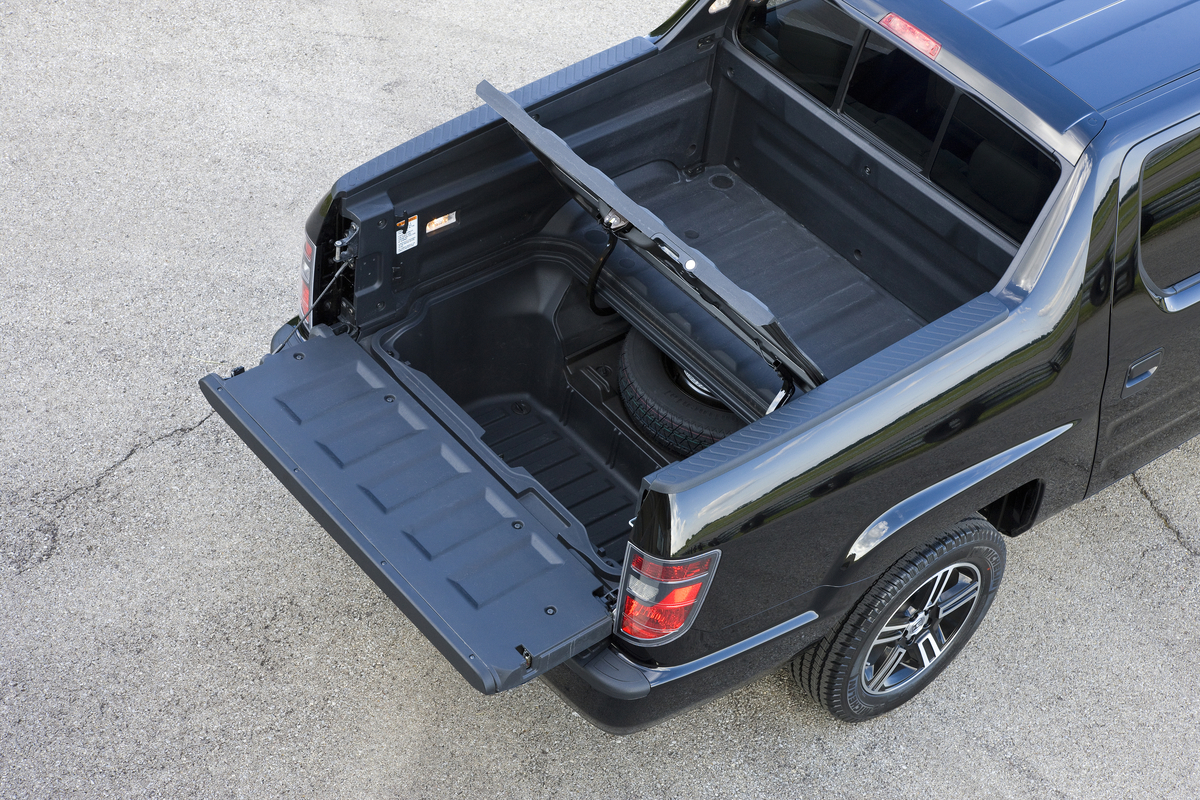
Tailgate drops or swings to the side. Trunk holds 8.5 cu. ft.
The truck bed, protected by a steel-reinforced composite liner, offers a two-way tailgate that drops down or swings to the side--something from the old Ford station wagons. And even more exciting--there's a lockable 8.5-cubic foot trunk built right into the bed--so you can stash things safely away from prying eyes.

Honda gives the Ridgeline a strong 3.5-liter v6 that puts out 250-horsepower and 247 lb.-ft. of torque through a five-speed automatic transmission. I did not haul anything in the bed, so I can't say how that would affect performance, but the V6 seemed to move the 4,500 pound vehicle with alacrity if not exactly daintiness down the road. Honda claims 1,100 pounds of payload and comparable towing ability to the pickup market leaders.

The EPA's fuel economy numbers are 15 City, 21 Highway and 17 Average. I accumulated 16.1 mpg during my time with the truck, about right figuring on a lot of in-town (not dirt road) motoring. EPA Green Vehicle Guide numbers are 6 for Air Pollution--pretty good--and 2 for Greenhouse Gas--dismal. This is not the poster child for Honda's environmental efforts, for sure.

Inside, the rugged, no-nonsense mood of a truck prevails, but it still has those squared-ring door pulls with their grippy inside surface. There's a satisfying rectangular feel, with the edges nicely rounded. The center console has loads of space, and slides forward to create more. The "above it all" feeling of a pickup is part of the Ridgeline experience, as it should be.

The rear seat lower cushion folds up, so you can carry a substantial amount inside the truck, including, say, your mountain bike (with the front tire removed). The back window slides open with the push of a button.

You can buy the Ridgeline in four levels, from RT to Sport to RTS to RTL. The equipment levels move up as you might expect, with, for example, a move from steel to alloy wheels between the RT and RTS and leather seating in the top-level RTL (and numerous other upgrades). The Sport is a new model this year. My Crystal Black Pearl test Sport tester showed this off, with its black 18" alloy wheels, black honeycomb grille with black surround and black headlight and taillight housings. See a theme here? While this truck, with its all-wheel drive, would gladly drive on a mountain road, you may not want to get the black paint too dusty, either.

Prices start at $30,180 for the RT and top out at $38,110 for the RTL with navigation system. My Sport came to $30,925.

The real question is, who is choosing the Ridgeline over the top-selling (since forever) Ford F-150, Chevy Silverado or Ram 1500? Despite its company name, the Ridgeline is substantially American, assembled in Lincoln, Alabama, and it contains 70 percent North American parts, including the engine and transmission. Most Civics and Accords for American consumption are built in the U.S. these days as well; Honda opened its first U.S. plant 30 years ago in Marysville, Ohio.

But are pickup buyers still wedded to owning one of the American big three? How is this truck playing in the American heartland or rural areas of the U.S.? Satisfied Civic owners may step up to an Accord--or an Acura--but it seems that Ridgeline buyers will likely come from people who test drive the truck and appreciate its comfort and features--and don't care what the neighbors think.