 |
| Unit-body construction and a one-piece look |
The Ridgeline holds five people easily--and they will be comfortable there. That's because, unlike your typical pickup, the Ridgeline is a unit body vehicle, rather than a body on a separate frame. It also has four-wheel independent suspension and front and rear stabilizer bars. Comfy.
You can tell there's something different when you look and see no division between the four-door cab and the five-foot bed. It's all integrated into one chunky piece. The sides taper back more gracefully than your regular truck.
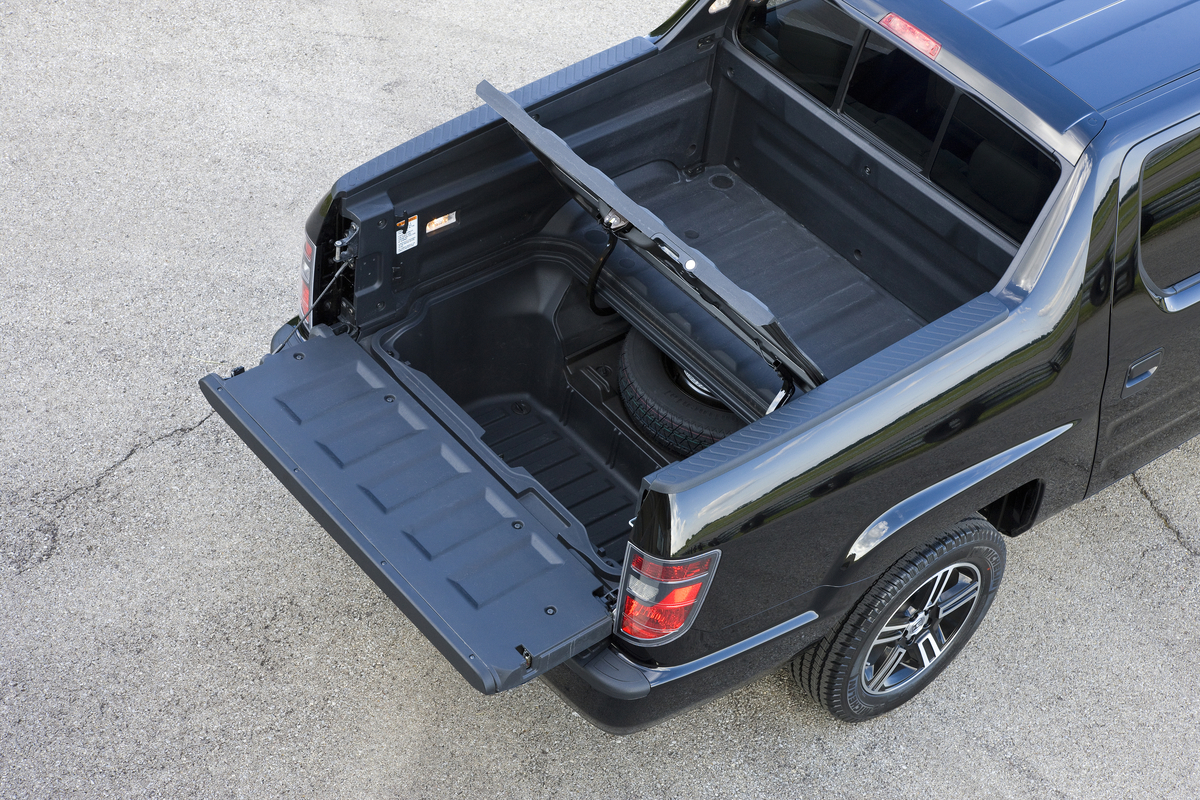 |
| Tailgate drops or swings to the side. Trunk holds 8.5 cu. ft. |
Honda gives the Ridgeline a strong 3.5-liter v6 that puts out 250-horsepower and 247 lb.-ft. of torque through a five-speed automatic transmission. I did not haul anything in the bed, so I can't say how that would affect performance, but the V6 seemed to move the 4,500 pound vehicle with alacrity if not exactly daintiness down the road. Honda claims 1,100 pounds of payload and comparable towing ability to the pickup market leaders.
The EPA's fuel economy numbers are 15 City, 21 Highway and 17 Average. I accumulated 16.1 mpg during my time with the truck, about right figuring on a lot of in-town (not dirt road) motoring. EPA Green Vehicle Guide numbers are 6 for Air Pollution--pretty good--and 2 for Greenhouse Gas--dismal. This is not the poster child for Honda's environmental efforts, for sure.
Inside, the rugged, no-nonsense mood of a truck prevails, but it still has those squared-ring door pulls with their grippy inside surface. There's a satisfying rectangular feel, with the edges nicely rounded. The center console has loads of space, and slides forward to create more. The "above it all" feeling of a pickup is part of the Ridgeline experience, as it should be.
The rear seat lower cushion folds up, so you can carry a substantial amount inside the truck, including, say, your mountain bike (with the front tire removed). The back window slides open with the push of a button.
You can buy the Ridgeline in four levels, from RT to Sport to RTS to RTL. The equipment levels move up as you might expect, with, for example, a move from steel to alloy wheels between the RT and RTS and leather seating in the top-level RTL (and numerous other upgrades). The Sport is a new model this year. My Crystal Black Pearl test Sport tester showed this off, with its black 18" alloy wheels, black honeycomb grille with black surround and black headlight and taillight housings. See a theme here? While this truck, with its all-wheel drive, would gladly drive on a mountain road, you may not want to get the black paint too dusty, either.
Prices start at $30,180 for the RT and top out at $38,110 for the RTL with navigation system. My Sport came to $30,925.
The real question is, who is choosing the Ridgeline over the top-selling (since forever) Ford F-150, Chevy Silverado or Ram 1500? Despite its company name, the Ridgeline is substantially American, assembled in Lincoln, Alabama, and it contains 70 percent North American parts, including the engine and transmission. Most Civics and Accords for American consumption are built in the U.S. these days as well; Honda opened its first U.S. plant 30 years ago in Marysville, Ohio.
But are pickup buyers still wedded to owning one of the American big three? How is this truck playing in the American heartland or rural areas of the U.S.? Satisfied Civic owners may step up to an Accord--or an Acura--but it seems that Ridgeline buyers will likely come from people who test drive the truck and appreciate its comfort and features--and don't care what the neighbors think.


 Posts
Posts


